The body awareness in Pilates It involves learning to perceive how the body moves, which muscles are involved in each exercise, and what adjustments it needs to work more safely and efficiently. It is not about doing more repetitions or moving faster, but rather about understanding movement and executing it with precision.
When we train automatically, it is common to compensate with areas that should not take on all the effort. Shoulders tense up, the lower back arches excessively or breathing is blocked. The conscious working allows these patterns to be detected and progressively replaced with more controlled and functional movements.
What does it mean to move with body awareness?
The body awareness It is the ability to recognise the position, movement and sensations of one's own body. It involves paying attention to aspects such as posture, breathing, balance, muscle tension or weight distribution.
In a Pilates session, this attention helps to answer important questions:
- Am I keeping my pelvis stable?
- Are my shoulders relaxed?
- Am I breathing during exercise?
- Does the movement stem from the right place?
- Am I feeling pain, muscular exertion, or unnecessary tension?
This observation does not seek to have the person analyse every movement in a rigid way. The objective is to develop a progressively more intuitive perception, allowing them to move with greater confidence both inside and outside the session.
Why is precision so important in Pilates?
In Pilates, a small, well-executed movement can be more effective than a large one performed without control. The movement precision allows the work to be directed towards the appropriate musculature, protects the joints, and avoids compensation.
For example, when raising a leg, the goal is not always to reach maximum height. If doing so causes a loss of pelvic stability or strains the lower back, the exercise ceases to serve its purpose.
Moving with precision involves respecting the range of motion that each person can control at that time. With practice, that range can increase, but always from a stable and conscious base.
Benefits of working on body awareness in Pilates
Training while paying attention to feelings and technical quality provides benefits that go beyond the session itself.
Improve postural control
Practice helps you become aware of how we position and move the body when standing, sitting or during any activity. Thus, it is easier to detect habits such as jutting the head forward, tensing the shoulders or putting more weight on one side than the other.
The objective is not to maintain a perfect posture all day long, but to have resources to adjust the position and reduce unnecessary tensions.
Help avoid unnecessary effort
Sometimes, when an area of the body lacks sufficient strength or mobility, another part makes a greater effort to complete the movement. This can generate tension or make the exercise less effective.
The body awareness in Pilates help to detect these imbalances and correct them through adapted exercises, precise instructions and better body alignment.
Improve coordination
Each exercise combines different elements: breathing, stability, mobility and control. At first, coordinating everything can seem complex, but conscious repetition improves the communication between the nervous system and the musculature.
Over time, movements become more fluid, organised and efficient.
Promotes more functional breathing
The breathing it is an essential part of the Pilates method. It not only accompanies the exercise, but also helps to organise the torso, manage effort and reduce stiffness.
Learning to breathe without blocking the abdomen or excessively raising the shoulders helps to perform the exercises with more control and less tension.
Increase safety during training
Sensing the body's signals helps to differentiate between appropriate muscular effort and discomfort that requires modifying or stopping the exercise.
This ability is especially important when there is a previous injury, stiffness, recurring pain or fear of movement.
How does body awareness develop during a session?
The body awareness It does not appear immediately. It is trained progressively through attention, repetition and professional guidance.
1. Carry out an initial assessment
Before starting, it is important to understand each person's mobility, posture, limitations and goals. This information makes it possible to select the appropriate exercises and establish a realistic starting point.
2. Learning to identify the starting position
Good execution begins before starting the movement. The positioning of the feet, pelvis, spine or shoulders directly influences the outcome of the exercise.
Taking time to prepare the body avoids starting from an unstable or strained position.
3. Use clear prompts
The instructions should help to understand the exercise without causing confusion. Instead of simply imitating a posture, the person learns what to activate, which area needs stabilising and in what direction to direct the movement.
4. Working at a controlled pace
Moving slowly does not mean training with low intensity. A pace control allows you to better perceive each phase of the exercise and detect when compensation occurs.
Speed should only be increased when technical quality can be maintained.
Adapt the exercise when necessary
Adapting an exercise does not mean doing it less effectively, but rather tailoring it to each person’s needs. Sometimes it is enough simply to change the range of motion, the resistance, add a support or choose a more suitable variation.
These changes enable us to work safely and progressively, whilst maintaining the current standard as we develop the force, the mobility and the trust in the movement.
The role of machines in conscious movement
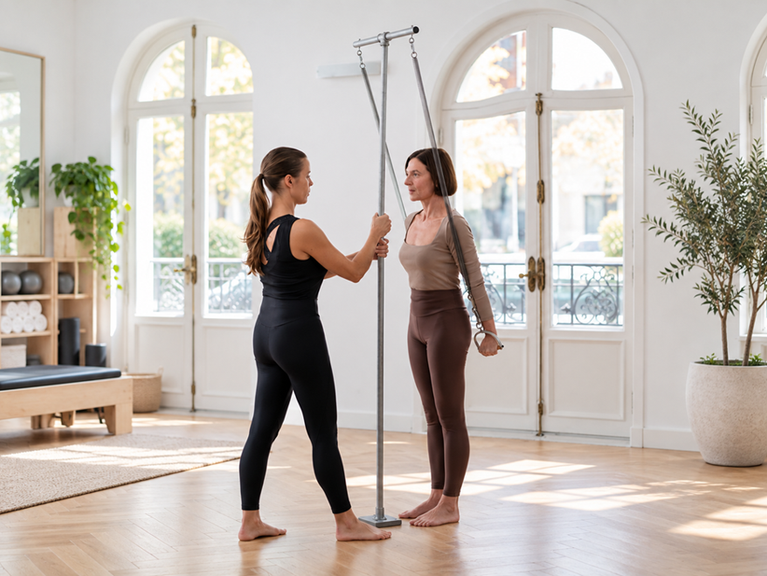
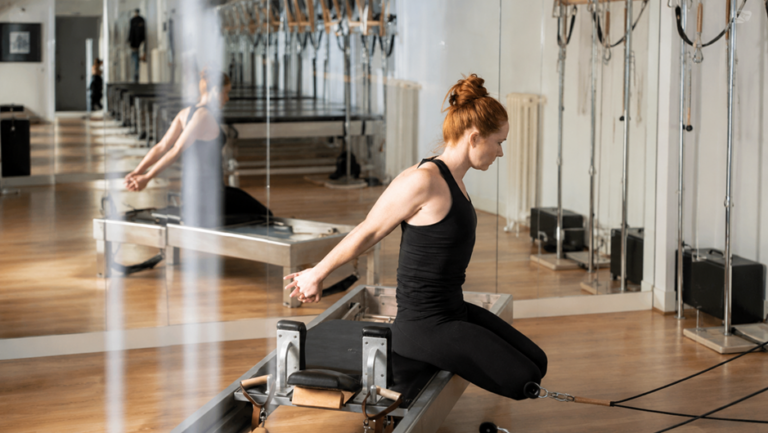
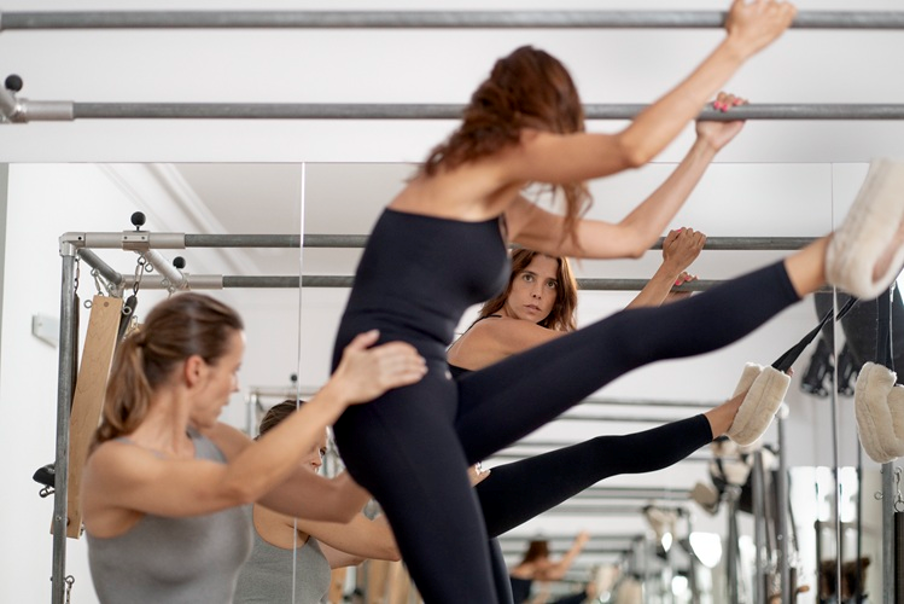
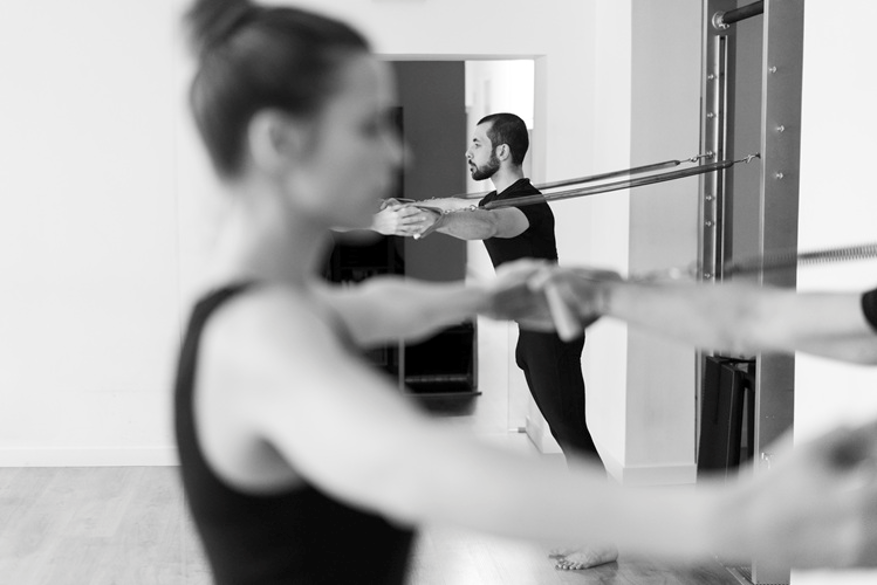
The Pilates equipment, like the Reformer, the Cadillac o the Chair, They provide resistance and support that aid body awareness. The springs can assist with some movements and add difficulty to others.
Their value does not lie solely in the variety of exercises. They also provide immediate feedback: whether force is applied unevenly, whether there is a lack of control or whether one side of the body is working harder than the other.
When used under supervision, the machines allow training to be tailored with great precision and enable each individual’s progress to be monitored.
Why does working individually improve accuracy?
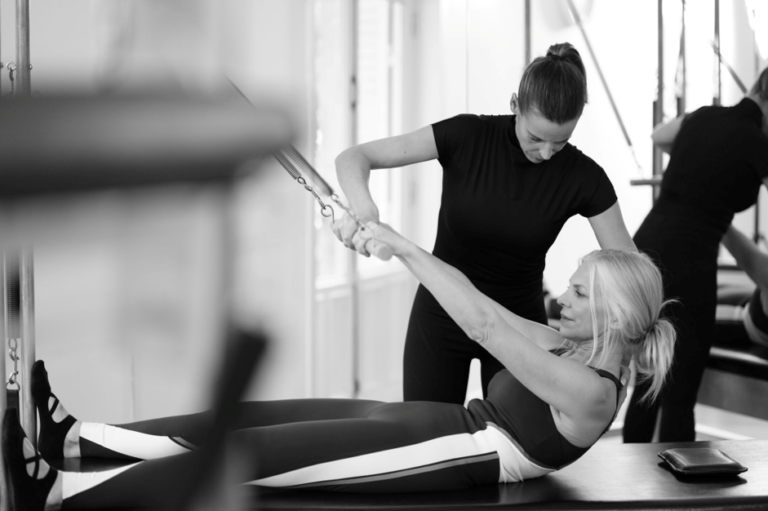
During a one-to-one session, the trainer can closely observe how the body responds, make adjustments and modify the exercise on the spot. This personalised attention is particularly useful for developing the body awareness in Pilates.
Every person has a different makeup, experience and set of needs. That is why the exact same instruction or exercise does not work in the same way for everyone.
Working individually allows you to:
- Adjust the resistance on the machines.
- Correct specific offsets.
- Take any injuries or limitations into account.
- Progress at the right pace.
- Design the sessions according to personal goals.
Common mistakes when practising Pilates
Some errors can reduce the effectiveness of training o create unnecessary tension
- Prioritising the number of repetitions over quality.
- Copying the movement without understanding it.
- Hold your breath.
- Extend the range of motion.
- Confusing tension with muscle activation.
- Carrying on with an exercise despite feeling pain.
- Comparing one’s own progress with that of others.
Pilates does not aim to achieve a perfect external form, but rather to develop movement that is organised, stable and tailored to each individual’s body.
Moving better also transforms everyday life
The awareness developed during the sessions can be carried over into everyday situations. Getting up from a chair, lifting weights, walking, working at a computer or practising another sport are actions that can be performed with greater control.
Over time, people learn to recognise when they are building up tension and have more tools at their disposal to adjust their posture, breathe or change the way they move.
Conclusion: train with precision to advance safely
The body awareness in Pilates turn training into a learning process. Every exercise becomes an opportunity to get to know the body better, correct inefficient patterns and develop more coordinated movement.
Precision, control and attention enable you to make progress without straining yourself, whilst respecting each person’s abilities and needs. It is not simply a matter of completing exercises, but of understanding how the body moves and using that knowledge to gain confidence, stability and well-being.
At Elite Pilates Madrid, you’ll find a personalised training, tailored to your level and designed to improve the quality of every movement. Book your class and discover how to train from awareness can help you move with greater precision and confidence.
Tell us what you thought of this article, please rate it (1 TO 5 STARS).