
Many of our clients practice one or more of these disciplines as a hobby. Therefore, today we dedicate this article to talk about them, commenting on some of their handicaps and what you can do so that their practice does not interfere negatively with the onset of ailments or injuries.
Padel
This is a dynamic sport where the body is subjected to fast and explosive movements on many occasions. But it is also one of those sports where we do unilateral work, as we normally hit the ball using our dominant hand.
These are two fundamental factors that we will take into account, because many injuries are generated by focusing on these two reasons.
Unfortunately in this case the list can be very long, but among the most common are the following:
- Ankle sprains
- Epicondylitis or tennis elbow
- Shoulder injuries (especially rotator cuff tendinitis)
- Plantar fasciitis
- Knee ligament injuries
- Wrist fractures (scaphoid bone)
- Low back pain
Skiing
Over the last few years, its practice has become more widespread, but the truth is that it is a sport that entails a certain difficulty and risk, which is why it is necessary to have certain qualities in addition to muscular strength and endurance, such as flexibility, balance and coordination.
In this case, the body is also subjected to rapid movements, but we also have to take into account that there are external factors that can have an influence, such as the quality of the snow. Especially when there are slabs of ice, there is a greater tendency to fall and thus to injure oneself.
On most occasions, the joint most affected during skiing is the knee, usually with injuries to the anterior cruciate ligament (ACL) and the internal lateral ligament (ILL). We can also find other types of injuries such as shoulder dislocations or the so-called “skier's thumb” where the ligament of the thumb is torn.
Golf
This is a sport that, contrary to appearances, requires a good physical condition. During its practice, powerful and wide-ranging movements are often performed. And the truth is that although in this case “each stroke is measured” and we have time to prepare and react, we can find ourselves with some typical injuries. Among the most common ones we can highlight:
- Epitrochleitis or golfer's elbow
- Fibrillar ruptures
- Cervical and low back pain
- Herniated discs
- Tendinitis of the shoulder, wrist or hand.
On the other hand, we must not forget that sometimes injuries are not caused by the practice itself, but by carrying the equipment. This generates a greater overload and stress, especially on the back.
What can we do to prevent injuries?
Although in principle we are talking about three different sporting disciplines, the truth is that they all share a series of general rules when it comes to trying to avoid injuries:
1. Work on technique: In my opinion, this is key and the number one rule to avoid injuries. Many of them in any of the three cases come from lack of knowledge, so I consider it highly advisable to take classes to learn correctly.
2. Warm up before starting: This is also essential, as if we are “cold” we are much more likely to suffer injuries.
3. Stay properly hydrated: This is essential in any sporting activity so that nutrients and oxygen reach our muscles better.
4. Stretch at the end: Yes, everyone forgets to stretch, but the fact is that it is a practice that you should not neglect to help eliminate tension and overload in different areas that have been more exposed and have worked hard. So in the case of padel and golf we will focus mainly on the arm and in skiing on the legs.
How can Pilates help us with its practice?
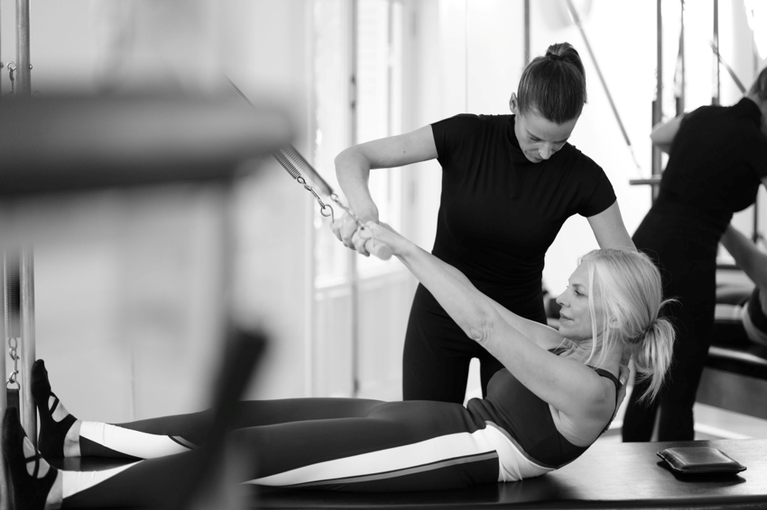
The Pilates method is the ideal complement, as it provides a series of essential benefits that prepare our body to avoid the risk of injury. Bear in mind that when performing fast and demanding movements where we also exert force, our joints, muscles, tendons or ligaments can suffer the consequences if we are not properly prepared. For this reason, the work will focus on:
1. Correct alignment: This is something that we don't usually pay too much attention to, however it is extremely important to keep our joints aligned when working, as this is the way in which the musculature can be strengthened correctly without putting pressure and wear and tear on them.
Thus, in the case of padel, we will work on the alignment of “the box” (the trunk), especially at the level of the shoulders, head and neck.
In the case of golf, we will also correct the alignment of the box, paying attention to the hips (starting point of the movement in the swing) and the lower back.
For skiing, it is also essential to work on the alignment of all the joints of the leg, hip-knee-ankle.
2. Strengthen the deep muscles: When the body makes fast, explosive movements, it calls on our largest and most powerful muscles to do so. But we must not forget the deep musculature, as it is responsible for supporting our joints.
In any of the three cases, working on the deep muscles of the spine and on what we call “the energy centre” (which includes the abdominal, lumbar and pelvic muscles) will be essential to provide stability to our body and protect it during sport. And especially in the case of golf, this will be one of the key points to work on, given that the movement generated when swinging can cause pain or injury to our spine and especially to our lower back as we do not have strong muscles at this level.
In the case of padel tennis, it will be equally important to specifically strengthen the deep muscles of the shoulder and ankle (remember that one of the most frequent injuries in this sport is sprains at this level).
For skiing, we will also work on strengthening the knee muscles to provide greater stability at this level.
3. Flexibility: It is necessary to work at this level, especially aimed at all the powerful musculature we were talking about, to eliminate the tension caused by the overload generated during the effort and thus avoid pressure on the joints.
In this case, we will try to make the chest muscles more flexible in the case of padel, where we will also stretch the arm and especially the forearm.
In the case of golf we will also work at this level, but we will also work on the opening and stretching of the lumbar area.
In the case of skiing, we will focus at this point on stretching and lengthening the leg muscles.
4. Acquiring control in movement: By working on the three previous points, the body is much more prepared for any impact or rapid movement to avoid injury. But in addition, controlling our posture, developing proprioception and developing balance will be three key points to develop greater control during sport.
The first of these will be particularly important in golf, where posture plays a very important role.
In the case of padel or skiing, we can do different specific exercises to help improve balance and proprioception, which will help us to maintain better control of our body in the most extreme circumstances.
Tell us what you thought of this article, please rate it (1 TO 5 STARS).