Returning to sport after injury should not be a race against time. The priority is to regain mobility, strength and control so that the affected area doesn't fail again at the drop of a hat. This is where Pilates can make the difference: it combines core work, posture and low-impact movements that are adapted to your level and recovery phase. In this article you'll see how to focus Pilates recovery on three areas of the body that are frequently injured: knee, shoulder and lower back. The idea is not to give you a “one-size-fits-all routine”, but to explain what each exercise block is looking for and what cues should guide your progress.
The Importance of Rehabilitation in Sports Injuries
Phases of recovery and the role of Pilates.
After a sports injury, recovery is not just about “pain relief”. Readaptation aims to get you back to moving well, with strength and without fear, reducing the risk of relapse. In general, you go through an acute phase (pain and inflammation), an intermediate phase of mobility and gentle strength, and a return phase where you retrain real sporting gestures.
Pilates is particularly suitable as post-injury Pilates because it allows you to progress with precision: low impact, conscious and fluid movements and controlled ranges. This allows you to work without punishing the affected area and avoids typical compensations (overloading the healthy leg, shrugging the shoulder or stiffening the back).
Why core strengthening is key after injury?
When a knee, shoulder or back hurts, the body changes the way it moves to protect itself. If this pattern is maintained, overloads occur in other areas. A strong core (deep abdomen, pelvis and lower back muscles) acts as a “base” to move arms and legs with stability.
In a sports rehabilitation process using the Pilates method, core work improves balance, coordination and load distribution: the knee appreciates a stable pelvis, the shoulder moves better with a firm trunk and the back suffers less when it does not have to compensate. For this reason, the core, or what we call in Pilates the energy centre, is one of the pillars of the method and its work is fundamental for the recovery of sports injuries.
Specific Benefits of Pilates in Rehabilitation
Restoration of joint mobility and range of movement
After an injury it is normal to notice stiffness and loss of range of motion: it is difficult to bend the knee, raise the arm or turn the trunk. Pilates prioritises the quality of movement: fluid, controlled and well aligned. This combination helps to recover mobility without forcing, mixing gentle activation with dynamic stretching. In addition, by working the body as a whole, you improve coordination and sensations: not only do you gain amplitude, you also “fit” the movement better.
Postural reeducation and prevention of future relapses
Many injuries are related to imbalances: lack of strength in certain muscles, poor technique or posture. Pilates trains alignment (spine, pelvis and shoulder blades) and body awareness, so that you can detect earlier when you are overloading yourself and thus avoid compensations.
This learning is key in post-injury Pilates: you return to training with more efficient patterns and, therefore, with less chance of relapse.
Pilates for Knee Injuries
Low-impact exercises to strengthen the quads and hamstrings
Using the Pilates method for an injured knee helps us to regain strength without impact. Quadriceps and hamstrings, along with glutes, are essential for stabilisation. We always start with a non-resistance workout to focus mainly on alignment. We will also avoid overloading the joint, so that we will work on mobility but always without causing irritation. The reformer will be of great help, but we must choose the right combination to avoid intra-articular pressure.
Initially we will seek to balance the body by working both sides as symmetrically as possible. Later on we can add exercises for unilateral work and descent/climbing control. The criteria is clear: no acute pain, clean technique and gradual progression.
Pelvic stability and its impact on the knee joint
The knee is very dependent on the hip and pelvis. If the pelvis gets out of control, the knee compensates (e.g. by dropping inwards) and tendons and ligaments are overloaded. Therefore, the programme usually includes core and gluteus medius to stabilise the hip.
When the pelvis is stable, alignment improves when walking, climbing stairs or sitting, and the knee receives “cleaner” forces. It's a global strategy: not just strengthening, but teaching the body to use the leg better.
Pilates for Shoulder Recovery
Activation of rotator cuffs and scapular stabilisers
The shoulder needs stability to move without pain. With the Pilates method, the painful shoulder is treated by working on the relationship between the shoulder blade, arm and including the cervical area: positioning the shoulder blades, relaxing the neck and activating the rotator cuff and scapular stabilisers with gentle push/pull exercises and postural control.
The aim is to regain a safe pattern: shoulders away from the ears, scapulae accompanying the movement and “fine” strength without overloading.
Controlled movements for the improvement of joint amplitude
Shoulder mobility usually recovers best with progressive exposure: raising/lowering arms in stable positions, chest openings, gentle rotations and thoracic mobility work (the upper back has a strong influence on the shoulder).
Rule of thumb: movement without sharp pain and with good alignment. If there is impingement, the range is reduced or modified. With consistency, joint range and, above all, confidence to return to training usually improves.
Pilates and the Rehabilitation of the Lower Back (Lumbalgias)
Deep core strengthening for lumbar support
In the case of back injury rehabilitation, the Pilates method focuses on achieving spinal stability by working on deep muscles (transversus abdominis, pelvic floor and multifidus).
When the core or energy centre “holds” well, the lower back feels more protected and it is easier to resume daily tasks and sport with less discomfort.
Stretching and gentle mobilisation to relieve pain
Low back pain is often accompanied by stiffness in the hips, hamstrings or dorsal area. Pilates combines activation with mobility to relieve tension without forcing.
If there are specific diagnoses (hernia, sciatica, etc.), adaptations are essential. In many cases, a well-guided post-injury Pilates routine allows you to move again without fear and with better habits.
Principles of Safety and Progression in Post-Injury Pilates
Adaptations and modifications of exercises with material
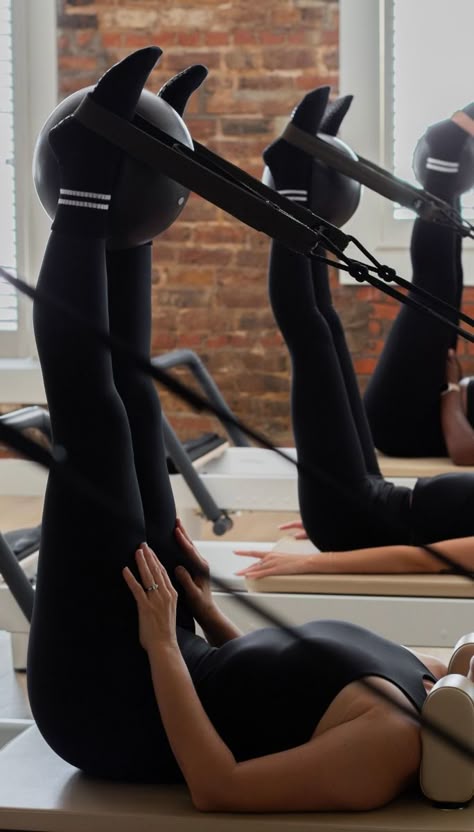
The reformer and, in general, all the apparatus of the Pilates method (Cadillac, chairs, barrels, etc.) are essential for optimal recovery. In early phases, they facilitate movement and protect the injured area; in advanced phases, they allow progress with control (more resistance, balance or coordination) and more analytical work depending on the ailment, the morphology of the person and their specific needs.
The rule is to progress only when there is good technique and the body responds well. Better is not harder: better is more stable and more consistent with your injury.
The need for monitoring and individualised approach
If your goal is to use Pilates as a method of recovery from sports injuries, it is ideal to have a professional with experience in rehabilitation. Supervision avoids compensation, adjusts exercises to your phase and ensures that you progress at a safe pace. It is essential to find qualified professionals who, as well as knowing the method inside out, are physiotherapists. This will also ensure knowledge of the body and the different injuries, as well as knowledge of how to approach rehabilitation and how to progress in each case.
The Role of Breathing in the Healing Process
Pain management and muscle relaxation through breathing
Breathing in Pilates is a practical tool: it reduces tension, improves core control and makes movement more fluid. With pain it is common to hold your breath and stiffen; learning to exhale during effort helps to relax the neck and shoulders and activate the deep abdomen.
In Pilates, breathing well often means moving with more control and less fear: the body stabilises without stiffening, which is key to returning to training with a good feeling.
A good Pilates programme is not a substitute for diagnosis or medical follow-up, but it can be a very powerful tool for consolidating recovery. If you use it as a Pilates sports rehabilitation programme, with progression and supervision, you will usually return to your activity with more stability, better posture and less fear of relapse. The key is to listen to your body, respect your timing and prioritise technique over intensity.
Frequently asked questions
When is the right time to start Pilates after an injury?
When acute pain and inflammation are controlled and your healthcare professional authorises it. Start with gentle, non-impact exercises in small ranges and progress according to tolerance.
What is the difference between rehabilitation Pilates and traditional physiotherapy?
Physiotherapy treats the injury with clinical tools and therapeutic exercises. Rehabilitation Pilates is guided and adaptive exercise that strengthens posture, control, mobility and core strength. They usually complement each other: physiotherapy for the clinical phase and Pilates to consolidate and get you moving better again.
Can Pilates be practised with chronic or degenerative injuries?
Yes, if it is adapted. In chronic problems (recurrent low back pain, tendinopathies, osteoarthritis) Pilates helps to maintain mobility and to strengthen and make the supporting muscles more flexible, reducing or eliminating episodes of pain. The key is supervision, the in-depth knowledge of the professional who knows how to make the most appropriate modifications in each case, and perseverance.
Tell us what you thought of this article, please rate it (1 TO 5 STARS).