Ankle sprains are quite common and are a real pain. They limit you because they prevent you from doing something as basic as walking normally, but they can also cause other problems in the future due to the adaptations that take place in the body after the new situation, if the recovery is not correct. For this reason, correct assessment and treatment from the earliest stages is essential.
Classification of ankle sprains
Ankle sprains are classified into 3 grades:
Grade I sprain: This is a mild sprain, in which there is a strain or overstretching of the ligament with a rupture of a fibre. Mild pain and some swelling may occur, but will appear progressively and not suddenly. There is little or no bruising and it does not usually cause instability.
Grade II sprain: This is a moderate sprain, in which there is a partial rupture of the ligament fibres. It is usually accompanied by haematoma, with swelling greater than that which appears in grade I sprains. The pain appears on the outside of the ankle and is accompanied by instability when walking or standing.
Grade III sprain: This is a severe sprain, where there is a complete rupture of at least one of the ligaments. It causes quite severe bruising, swelling and pain along with significant instability of the entire joint.
What can we do if we suffer a sprain?
If you have been unlucky enough to suffer a grade 3 sprain, where you may have been immobilised because in addition to a torn ligament you have also suffered a crack or fracture, you will have to wait 3 weeks to a month to start treatment.
If, on the other hand, your sprain has not been so serious, I insist, you have to start treating it from day one. And to do so, you should go to your physiotherapist so that he or she can act effectively on the injury and thus make a better and faster recovery.
Treatment by physiotherapy
In the first phase, treatment is essential to help eliminate inflammation and considerably reduce pain. Within physiotherapy and in the most acute stage, we apply:
1. cryotherapy and circulatory massage to drain any oedema that may have been caused by the trauma.
INDIBA treatment: To help improve circulation and stimulate regeneration of damaged tissues.
3. We advise the patient to take some self-care: such as the use of an anti-inflammatory ointment (preferably natural, with arnica) and, when resting or sitting, to do so with the foot elevated to also help circulation and therefore reduce inflammation.
Later on, we will also apply other techniques such as:
4. Deep transverse massage to act more directly on the ligament.
5. Techniques to normalise movement between the different joints of the foot that have been blocked, check the mobility of the bones of the foot (especially the calcaneus, talus, tibia and fibula), in addition to checking if there have been adaptations after the trauma that have caused blockages in the rest of the leg, or even in the spine.
6. Functional bandages that allow mobility but can block the ankle in potentially dangerous movements. We tend to use these functional bandages more in grade 2 sprains, where the tear is greater than in grade 1 sprains and therefore the instability is greater. If the sprain is mild, they are not strictly necessary in principle.
Treatment and prevention using the Pilates method
Once the swelling and bruising has gone down, it is time for more specific and active work on the part of the person. This will help us to deal with imbalances in order to avoid incorrect function on a day-to-day basis and other ailments or injuries that may appear sooner or later as a result of adaptation.
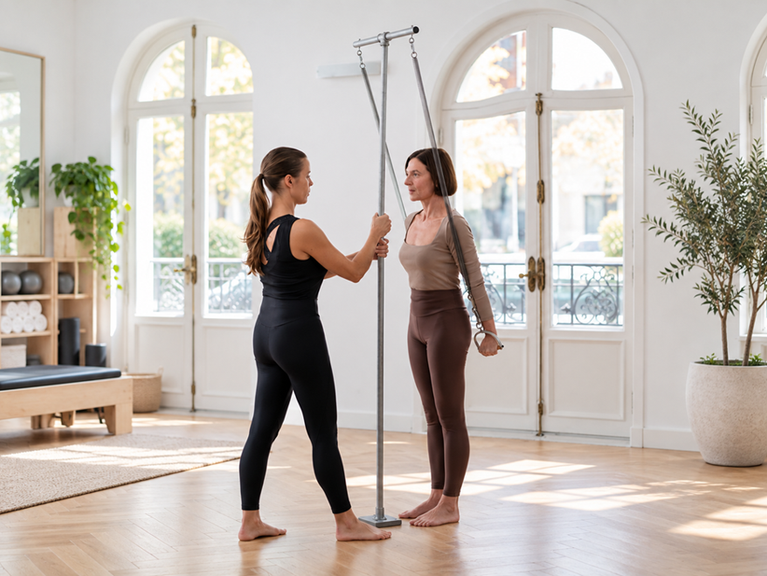
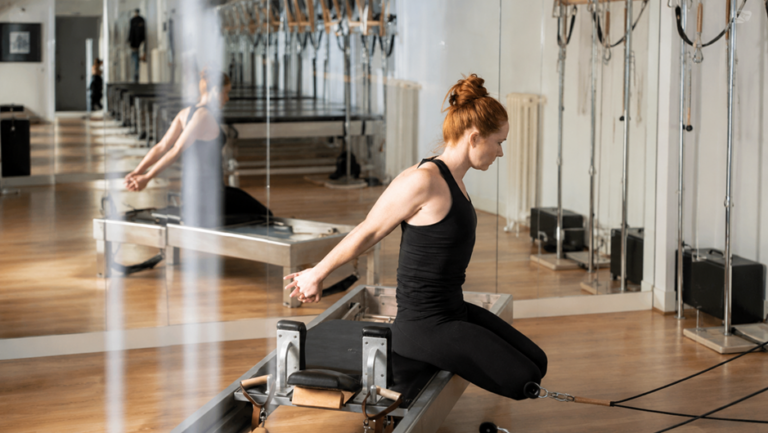
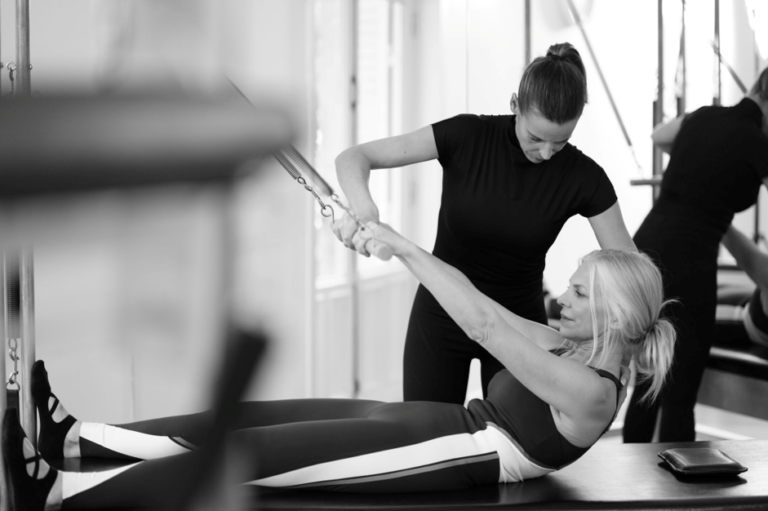
For this we work with the Pilates method, as it is a fundamental technique to not only help us to recover, but also to help us to prevent adaptations and to prevent the problem from recurring.
We will always work from a global perspective, bearing in mind that the whole body is connected and has most probably undergone different changes and compensations simply because it has not been able to walk properly. We will also carry out specific work focusing on the ankle, avoiding pressure and pain.
We will focus on:
1. Mobilise the ankle with correct alignment, taking into account the whole body structure and especially the hip-knee-ankle joints as a whole.
2. Reinforce the musculature, strengthening and balancing it so that the joint can be protected against any impact.
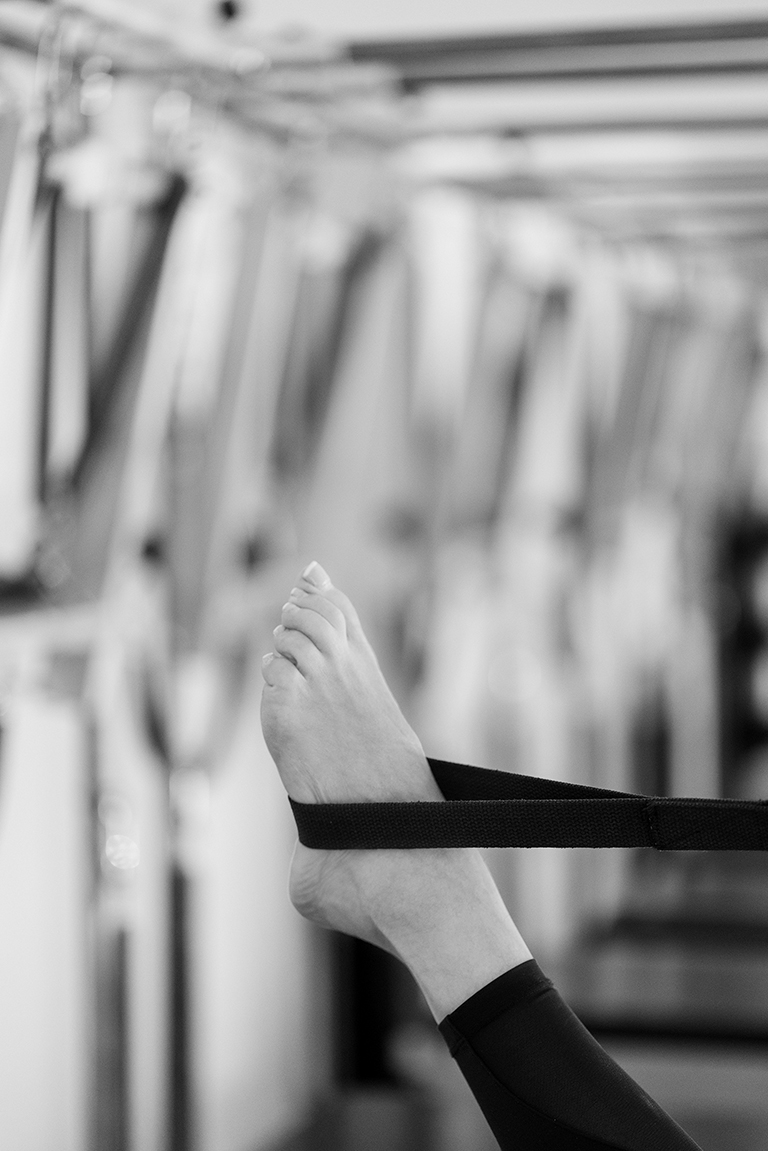
3. Work on proprioception and balance to correct the correct foot support and provide the necessary skills to react correctly in any situation.
All this is achieved by working on the reformer (the main and essential piece of equipment) and on the mat. But it is also vitally important to have the help of the other apparatus, which will allow us to do more specific work on the ankle at the end of each session. The combination of all of them will be the key to achieve a complete recovery and prevent this or other associated problems in the future.
Tell us what you thought of this article, please rate it (1 TO 5 STARS).