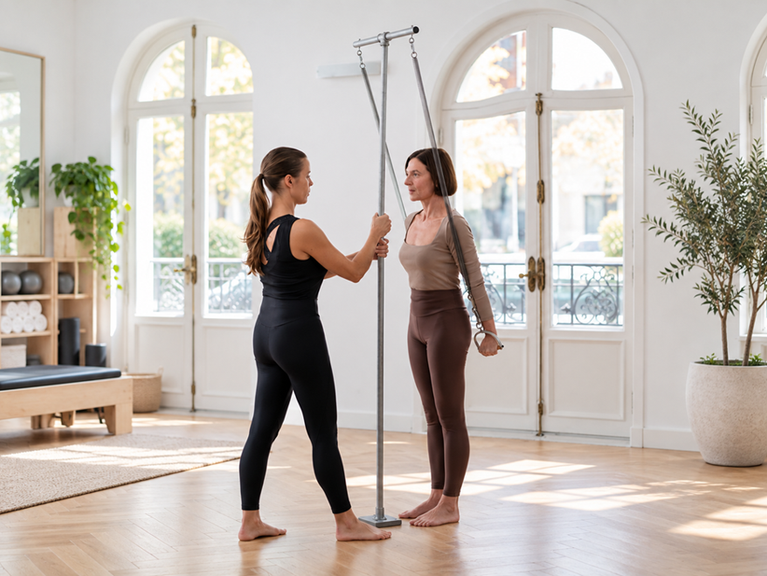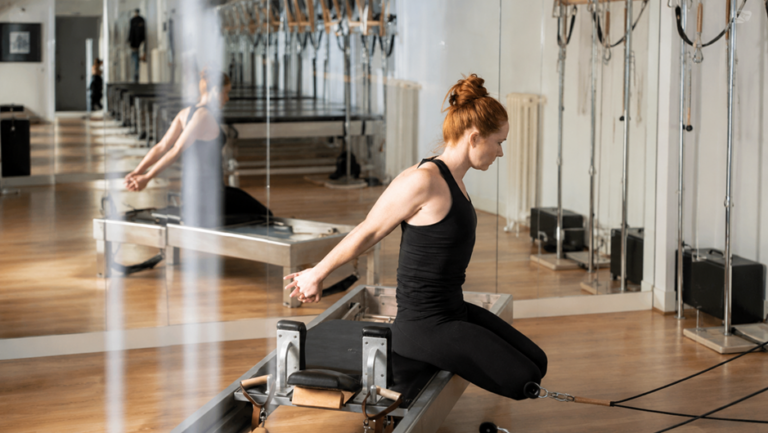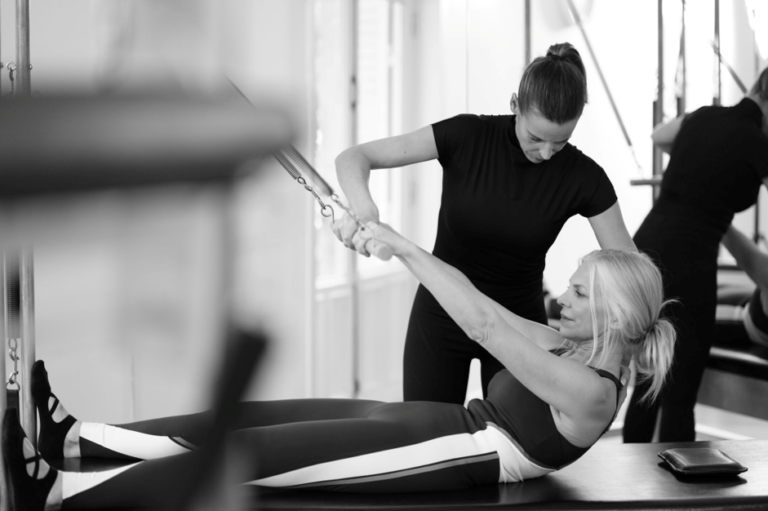

We spend many hours sitting or standing in a certain position and performing repetitive or forceful movements. It requires inadequate postures and overexertion that lead to muscular fatigue as the body is not sufficiently prepared to cope with them.
This, on many occasions, will cause one of the most common discomforts today, such as neck pain or “cervical pain”, which is also associated with stress overload and the natural wear and tear caused by age.
The Pilates Method will work on our posture and will prepare our neck for daily demands, gaining stability, strength, resistance and mobility, which will give us more confidence when it comes to involving it in our activities without feeling overloaded or in pain.
By strengthening the musculature of the centre of our body, the “Powerhouse”or “energy centre”, We will adopt a correct posture for the whole spine in any activity or task, essential for our health, correctly aligning the neck and shoulders, both in movement and static, thus avoiding contractures due to overload, relieving pain and preventing other injuries.
Benefits of Pilates for Cervical Health
- The Pilates method provides us with a great deal of work on body awareness and proprioception necessary to achieve greater motor control of the position and movement of the neck.
- It will work on the strength of the internal and stabilising muscles, improving the coordination of muscular activity, thus achieving greater mobility, consistency and fluidity in cervical function, by relieving tension in areas that don't need it and relieving your pain.
- The shortened muscles will be lengthened and the weak muscles will be strengthened, achieving a correct balance between the muscle chains and favouring a correct posture.
- The work of our energy centre makes us work in an analytical way on our spine, exercising its mobility and flexibility, strengthening the muscles that support it and thus releasing pressure in the cervical area and the rest of the spine, maintaining harmony between the vertebrae.
- With its work on elongation, alignment, flexibility and muscle tone, the vertebrae, intervertebral discs, ligaments and spaces through which nerve roots pass will be free of any pressure and irritation that can cause pain and injury.
- Breathing work makes us exercise the intercostal muscles, which, as well as helping us to increase our lung capacity, makes the dorsal spine more flexible, giving it greater mobility and avoiding rigid and weak areas and taking pressure off the cervical area.
- It is an ideal training to prevent future problems caused by overexertion, bad posture, physical demands, lack of training or sedentary life.
Specific Pilates Exercises for Neck Pain
With the Pilates method we work in a global and integral way. The exercises will be executed taking into account the alignment of all body structures and generating effective and efficient movement patterns to improve functionality as a whole.
All the exercises are based on the strength of the “.“energy centre” or “Powerhouse”The motor is generated in order to go to the more external and distal areas, favouring joint stability and rebalancing of the muscle chains.
Bearing in mind the above, only with a good positioning of the head with respect to the cervical and the rest of the spine, and a correct positioning of the shoulders, while we perform exercises using the Powerhouse, Whether lying on your back, sitting, kneeling or standing, we will ensure that the neck receives an efficient workout to reduce pain. With this, we intend that all the strength is carried out and comes out of the centre of the body, removing tension from the cervical and shoulder area.
Based on this, the method also includes exercises in which the neck takes on a more prominent role in which specific qualities are worked on in the neck, such as stability, strength, mobility, or motor and postural coordination:
- Craniocervical mobility exercises to lengthen the posterior muscles and tone the anterior internal and flexor muscles.
- Stabilising the rest of the body with the strength of the centre, we will perform cervical movements of flexion, inclination, rotations, or combinations between them, always maintaining correct alignment, harmony and fluidity in their movement.
- We will also incorporate exercises to strengthen the muscles of the rib cage and the back, arms and shoulders, using resistance with the springs provided by the apparatus of the method while keeping the neck well aligned.
- We will also use the resistance of the springs and straps to strengthen the muscles between the shoulder blades while giving elasticity to the chest and shoulder area.
- Spinal mobility exercises in all its movement patterns, focusing on the dorsal area to make it more flexible and take tension off the neck.
Tips for Practising Pilates Safely with Neck Pain
At Élite Pilates we help the body to develop uniformly, seeking the correct postural pattern by working on all the necessary qualities. We consider that these characteristics are what the body needs to be healthy and to perform any action of the day to day in a healthy way, without pain or injury.
- One of the fundamental concepts in the Pilates method is the use of the centre line, from head to toe, which divides the body into two symmetrical and aligned halves. The head should be held erect over the shoulders while maintaining the centre line.
- Based on this alignment we will control the movement of the neck and spine and rebalance and strengthen its musculature.
- The head shall be well positioned in relation to the cervical vertebrae.
- We will make our gaze help us to maintain the correct position of our neck with the rest of the spine and limbs, without incorrectly conditioning our body posture and movement.
- The shoulders shall be well aligned with each other and at hip level, forming a box which should be symmetrical to avoid postural imbalance and thus muscular overload.
- We must be careful not to put the weight of our body on the neck or shoulders, or use springs or weights on the arms without first mastering the stability work of our shoulder girdle with the correct position of the spine and neck.
Tell us what you thought of this article, please rate it (1 TO 5 STARS).