
Nowadays, with the pace of life we lead, it is very common for stress and anxiety to arise, which can have negative effects on our physical and mental health. For this reason, it is very wise to practice disciplines such as the Pilates method, that help to reduce and prevent such levels.
The method not only integrates physical work, but also mental work, through the development of body awareness in coordination with breathing. It will make us focus our concentration exclusively on our body and its rhythm, avoiding distractions and fleeing from the worries or problems in which we are involved, and with the urgency and speed that the day to day demands of us.
Establishing a routine of sessions will help us to become more aware and reduce anxiety levels. It will keep us more present and better able to handle situations that would present as “stressful”.
With its practice, we will achieve a global physical training from a state of body-mind balance, modulating their responses. We will be able to control our areas where we tend to accumulate more tension, achieving a good rest afterwards.
Benefits of Pilates for anxiety
The Pilates method for anxiety uncovers a number of benefits not only for the body, but also for the mind:
- It helps us to develop our body awareness, allowing us to get to know our body better in order to improve our limitations and enhance our qualities.
- It increases the ability to concentrate and mental control, keeping us present at all times.
- It improves breathing and blood circulation, leading to a greater state of physical and mental relaxation.
- It helps you get the rest you need to perform better and maintain good physical and mental health.
- It increases self-esteem, favours self-knowledge and greater confidence in our own abilities and qualities, gaining self-confidence.
- It boosts energy levels and the immune system, providing vitality and mental strength.
- In certain psychological profiles such as those with attention deficit or hyperactivity, it can be an effective tool for channelling energy levels and emotions, improving the ability to concentrate and maintain focus on important tasks, improving performance.
All these benefits will help us to combat stress and anxiety, leading to greater physical and mental well-being and will change the way we perceive other areas or aspects of life that worry us or influence us negatively, transforming it into a more positive way of thinking and personal growth.
Improved breathing and relaxation
The method focuses on a deep work of breathing as a link between body and mind. It helps us to feel our body much better and to seek and achieve the activation of the energy centre, from which the strength and control of movement comes from.
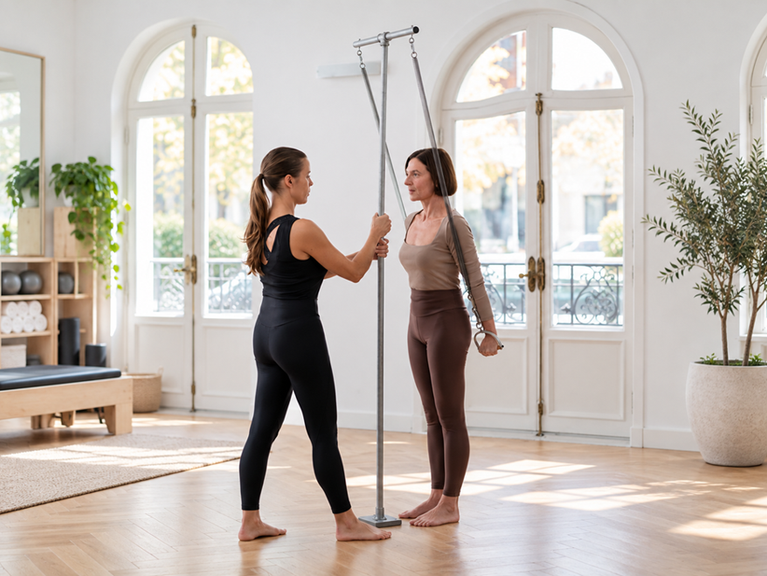
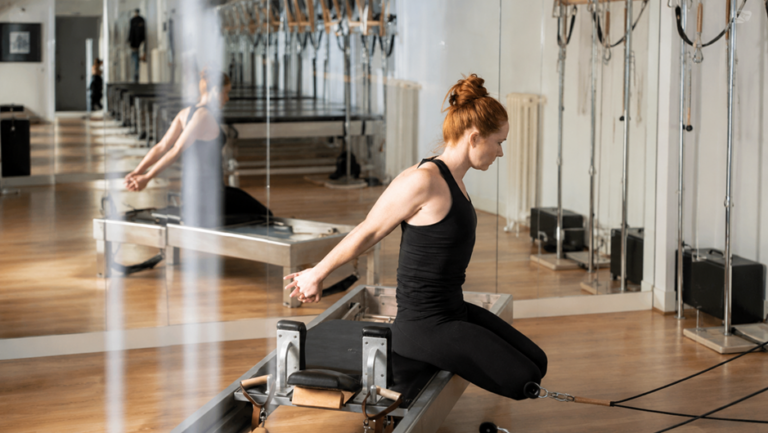
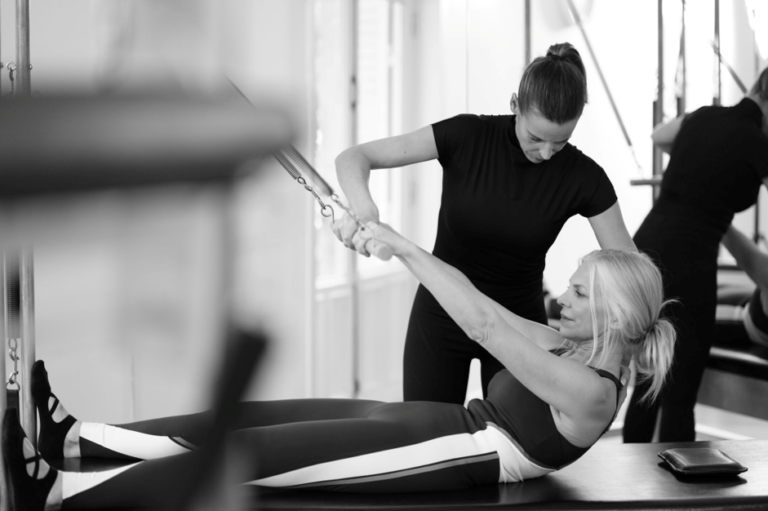
During a Pilates class, with particular emphasis on breathing exercises such as the “Hundred”, “Spine Stretch forward”, “Double leg stretch” or “Saw” on the mat, or the “Coordination“ and “Short box series” on the reformer, we will always try to perform a costal breathing with the aim of strengthening our core and, in turn, freeing and making our ribcage more flexible, increasing our respiratory capacity.
It will favour the movement of the entire spinal column and will allow us to position the shoulder girdle, balancing the position of the shoulders with the neck, removing tension from them, acting directly on physical and psychological stress.
Breathing correctly will allow us to move fluidly, without blockages. It prevents us from forced postures, visceral compressions or back pain due to stiffness in the rib cage, promoting its relaxation.
Stress reduction and mood enhancement
Regular practice of Pilates for anxiety has positive aspects on the brain. During the classes we release endorphins, neurotransmitters that make us feel happy and in a state of well-being.
Among other factors, there is an increase in the levels of serotonin (happiness hormone), which is involved in most psychological and vegetative processes such as mood, sleep, appetite and sexuality.
It also increases levels of Gaba, which is responsible for reducing stress and anxiety, helping us to reduce our levels of tension, anxiety and nervousness.
There is also an increase in dopamine levels, which are related to joy, motivation and euphoria.
On the other hand, by working together with our concentration and deep and conscious breathing, we will oxygenate the tissues and organs and our body will release tension where it is not needed, relaxing the muscles and acting directly on the physical, psychological and emotional stress that sometimes becomes the cause of psychosomatic pain, which will also be reduced.
Knowing how to control our breathing will also help to reduce stress and anxiety levels, calming the mind and thus also improving our quality of sleep, forgetting our daily burden and problems. It promotes rest and relaxation and, as a consequence, improves the person's mood and quality of life.
Increased body awareness and control
In training with the Pilates method, the work of body awareness is very present. The exercises are performed with an exhaustive control that leads us, with our concentration, to obtain very precise movements, feeling and identifying the body structures and taking control of the movement of every millimetre of our body. This is why the method was also called “Contrology”, paying attention to this control of the mind over the body, which makes the method go much further than simple gymnastic exercises.
A good body awareness will allow us to perform quality movements that involve less wear and tear and to identify a movement that could hurt us before we do it. If we are able to feel how the body behaves with a discomfort when we move, we will also be able to correct it and not wait for it to get worse.
People with less developed body awareness tend to feel more insecure and handle pain less well. They also show low self-esteem and more depressive symptoms, leading to situations of insecurity with their own body and its functioning.
On the other hand, those with more awareness have more self-acceptance, greater vitality and less physical pain.
Reducing anxiety through mind control
Pilates for anxiety is a demanding work method in which the whole body is exercised in a holistic way. From the beginning, and throughout the session, it is necessary to establish, through our concentration, a connection between body and mind. This will not only help us to improve our physical condition, but also our mental control.
Joseph Pilates aimed through mental control, to bring full attention and achieve a much more intelligent way of working with movement, making it conscious, with an appropriate rhythm, smooth and fluid, giving more importance to quality than quantity, without overloading or causing tension.
This form of training, including all the exercises of the method, will also help us to exercise our memory in execution and space, being able to focus on single stimuli accompanied by our breathing and ignoring
other external stimuli that are not necessary for us at the time, even if they motivate us more, thus establishing a priority.
This mechanism, taken to daily life, tends to reduce the levels of stress and anxiety that sometimes become the cause of psychosomatic pains, which will also be reduced, forgetting our daily burden and problems and making our daily life easier.
to help us in our daily lives.
Tell us what you thought of this article, please rate it (1 TO 5 STARS).