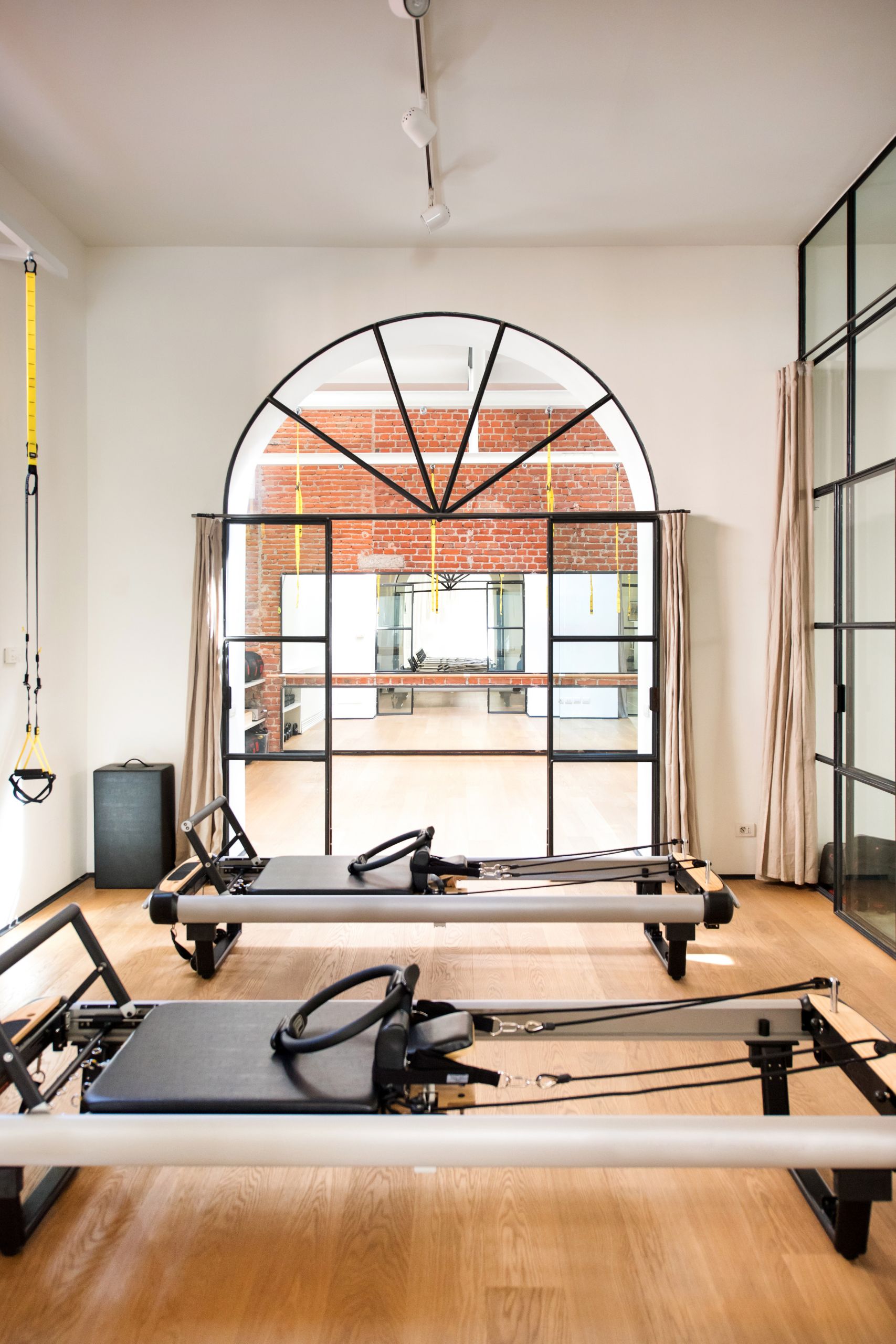
In order for our body to get a good workout with the method Pilates, The sessions should consist of doing a part of the work on the Reformer and another part on the mat, complementing the other part of the work on other apparatus systems, which is why the combination of both is the most appropriate and effective.
In general, the session always starts on the Reformer. Only in some cases, if the situation requires it, and depending on the physical characteristics, knowledge of the method and the person's ailments or injuries, we will, as an exception, start the class on the Mat.
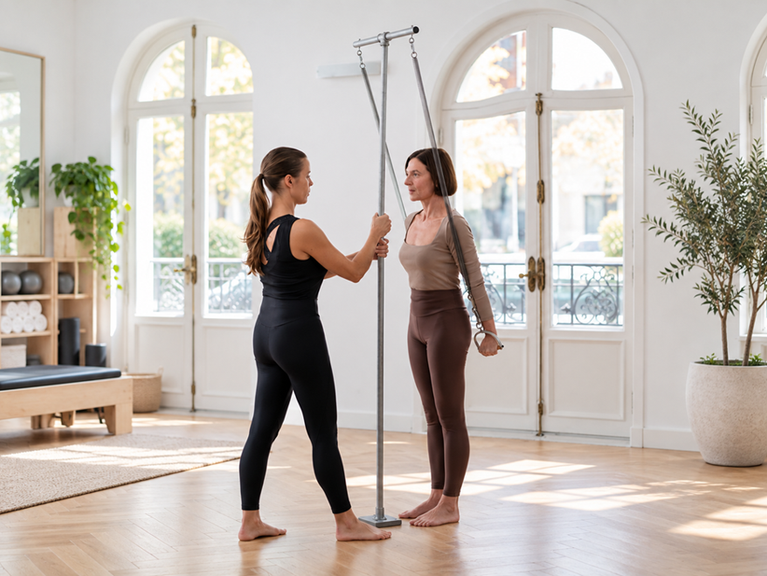
The apparatus of the Pilates method is designed to work exhaustively on body alignment, seeking symmetry and equidistance between its parts. The layout of its structures, its handles, support blocks, pedals or its strap or spring attachments make the body work in a functional and homogeneous way between its two body sides.
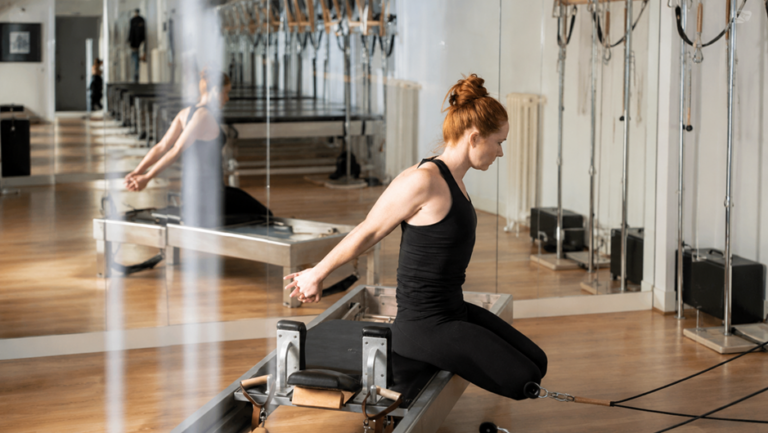
In addition, the system of springs and resistances that the apparatuses have offers us a double function: to assist and to resist the movement. This also allows us to regulate the intensity and work according to the needs and objectives of each person. This makes it a great help in establishing a training programme for the elderly, people with reduced mobility or with various pathologies or convalescence.
Exercises on the mat, on the other hand, are performed with the body free and with its own weight, in a constant challenge to the force of gravity. Although there is no external resistance, there is also no assistance offered by equipment. This gives it an even more demanding and intense character at certain times, complementary to what is done primarily on the Reformer.
It is important to concentrate hard and make sure to perform the exercises from the centre of energy. In this case, it is more intense as there is no assistance from springs or external forces to help us find and concentrate that strength.
Pros and cons of Pilates with apparatus
The use of apparatus in the Pilates method brings us a multitude of benefits:
- It helps us to better find the energy centre and with it, stabilise and strengthen the entire internal musculature, protecting the joints.
- It allows us to feel and concentrate more on our muscles and joints, thus facilitating movement.
- Muscle decompensation and joint alignment are better highlighted, allowing weaknesses and functional limitations to be clearly identified and then worked on in a more specific way.
- It carries out important work on the spinal column in all its amplitude and function, stabilising, strengthening and making it more flexible.
- Improves coordination of movement and increases joint range of motion, flexibility and muscle elasticity.
- The use of the counterforce offered by the apparatus allows us to work better on flexibility in body areas that suffer more stiffness.
- The eccentric work provided by its resistance lengthens the muscle chains and slims the figure.
- It enhances the respiratory work much more in exercises in which, with the resistance of the springs, we work the capacity and strength of the musculature of the rib cage.
- It gives us the possibility of using the correct load to exercise our body safely and without overexertion, allowing the prevention of damage and injuries. Even if we already suffer from an injury, its adaptability helps us to improve and reintegrate it without losing training and functionality in the rest of the body.
In fact, the implementation of the method with devices has virtually no cons, The session can be adapted to any type of person or physical condition, but there are certain things to bear in mind:
- The equipment used is exclusive and specific to this particular method and no other type of equipment is suitable. Otherwise, we would be talking about another type of training and not about original Pilates as such.
- The space we need for the placement of the equipment will be larger, especially if we want to have a Reformer or a Cadillac. Other devices such as the Electric Chair, Large Barrel or Wunda Chair will need less space.
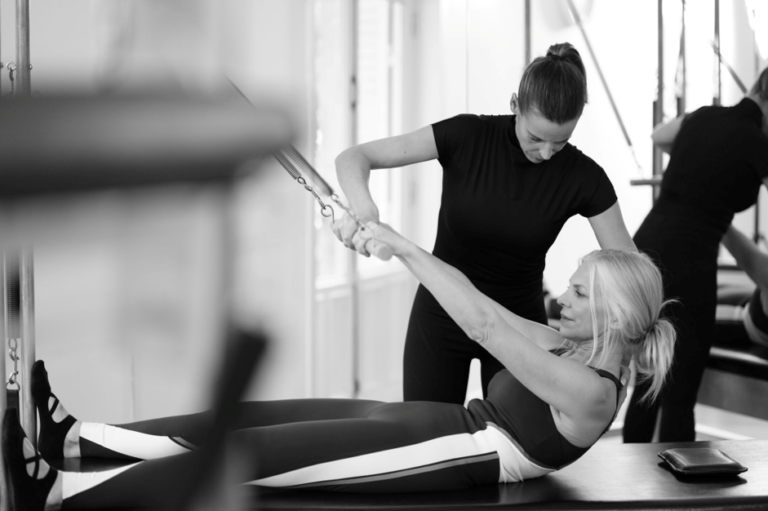
- The use of this type of apparatus in people with a lesser mastery or knowledge of the method always involves a greater risk for the person if they are not supervised by a professional, as they may suffer damage or injury when performing an exercise that does not benefit them or for which they are not yet prepared.
- For this reason, it is recommended that the work sessions on the apparatus of the method are individual, where the professional focuses all his attention and makes the most of it to achieve a quality of work without any risk.
Benefits of floor Pilates
The mat exercises or Mat help to work the whole body as a whole achieving:
- Strengthening the energy centre and with it, the entire inner musculature.
- Work on body awareness, which enables better identification of body structures, their action, their function.
- Improves coordination of movement and increases joint range of motion, flexibility and muscle elasticity.
- Strengthens and tones the musculature, seeking a balance between the muscle chains.
- It increases flexibility, specifically targeting the stiffest areas of the body, especially the spine.
- Improves body posture and slims your figure.
- Helps to reduce stress and improve rest.
- It increases energy levels and improves mood and self-esteem.
- It supports the nervous system and strengthens the immune system.
- It activates the circulatory system and boosts respiratory work.
- It is an intelligent, healthy and safe training method, indicated to prevent muscle and joint pain and injuries and to help recover from them if they already exist.
Perhaps one of the main benefits of practising the method on the floor is that, to do it and continue working outside the studio, we only need a mat and little space.
In addition, we can use the Pilates method as a complement to other sports or as a daily training routine. It is very efficient to choose the ones we are most interested in working on, depending on our physical needs, our general state at that moment or the specific sport or activity we are going to do. Even when we have suffered an injury, it allows us to adapt the exercises to improve their function.
The mental concentration and safety of performing the exercises from the energy centre will help to achieve the balance and coordination necessary to achieve exquisite control of the body without external forces interfering with it, which is a greater challenge to control our own body by having a greater awareness of it, being able to apply it to the postures and positions we need to adopt to carry out the activities and gestures of daily life.
Differences in the Pilates experience
In the Reformer and Mat exercise programme, their sequence and progression is executed continuously, linking them with transitions in which it is extremely important not to lose the awareness of our body connected to our mind through concentration, thus maintaining, at all times, the control of any movement or exercise from the moment it is performed. Powerhouse.
It is true that, in the Reformer, we must try not to lose that fluidity when incorporating the handling of its mobile structures such as the headrest, straps, springs, footbar or box to prepare the following exercises, something that does not happen in the Mat, but its use gives us an exquisite mastery of the apparatus that will give us even more control over our own body.
The use of devices in the rest of the system will become more specific by focusing more on the deeper work objectives needed by the individual, so that many of them no longer follow a set sequence, but can be performed in isolation.
In this case, the design of the rest of the system's apparatus is focused on achieving, among others, a series of more specific objectives such as: Alignment and balance in the Electric Chair; The flexibility of hips or the mobility and strength of the spinal column in Large Barrel o shoulder stability and strength of the ribcage and shoulder girdle in Baby Chair (especially in children or people who have suffered a shoulder girdle injury) among others.
Tell us what you thought of this article, please rate it (1 TO 5 STARS).