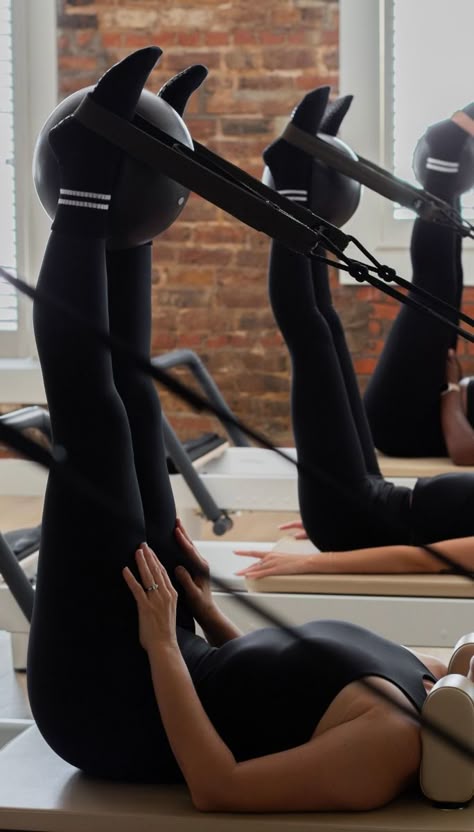

Back pain is a problem that affects a great many people. And if there's a method that truly strengthens and cares for the back, it's the Pilates. Maintaining incorrect postures for a prolonged period, as well as to make movements incorrectly and often in a repetitive manner, contributes to muscle imbalances, which in turn cause our joints to receive greater pressure and, consequently, greater wear and tear., potentially causing discomfort, pain, or even injury.
To all of this, we must also add sedentarism, which nowadays is much greater and contributes very negatively to back pathologies, further accentuating what was commented on previously.
Pilates is so beneficial for the back because it focuses on strengthening the core muscles, which include the abdominals, back extensors, pelvic floor, and diaphragm. A strong core provides essential support for the spine, helping to improve posture, reduce strain, and prevent injuries. Pilate's emphasis on controlled movements and proper alignment also promotes spinal health and flexibility.
On the one hand, because It is a method that works the deep musculature., which is that small musculature that stabilises our joints; by working on it, we protect our body structure so that the movements generated are always correct.
On the other hand, at not only strengthen but also flexibilise our muscles, ensuring optimal conditions by also restoring the balance that is lost when, depending on each case, Some muscles or muscle groups are more overloaded due to overuse. whereas others end up weakening through not requesting them habitually.
Furthermore, during the practice of the method It aims to restore full and correct mobility to each of our vertebrae. This is fundamental to avoid blocking movement in one or more of our vertebral levels, which causes our body to provoke a compensations that can end up causing injuries such as herniated discs or osteoarthritis.
With the Pilates method practically all back pathologies can be treated and prevented. This method has infinite possibilities for adaptation, but it is fundamental to know that it really works when we apply the appropriate exercises in each case and modify them whenever necessary, in the right way. That is why Work should always be individual, as one must take into account not only the injury itself but also other aspects. fundamental characteristics of the person, such as their morphology, their general physical conditions, or the way their body moves and the compensations it tends to make, in order to go correcting in a very specific and particular way in each case.
Are many sessions needed to look after your back? Although At first, it is recommended to have two weekly sessions so that learning and progress are faster. and to progress faster, the most important thing is consistency, effort during the session and, very importantly, trying to apply the concepts that are taught afterwards in everyday life. So, If you're short on time, just one Pilates class a week could help keep your back healthy. and avoid pain.
7 Pilates exercises for your back that you can do at home
Pilates preparation, leg raise to 90º
Lie on a mat with your knees bent and the soles of your feet flat on the floor.. Leave your arms relaxed by your sides and keep your gaze fixed on your knees to try and lengthen your neck.
Before we begin with the movement, It is necessary for you to focus on pressing your back down, noticing how it adheres to the mat. across its entire surface. To do this, you must exert a force from your abdominal area, trying to pull your navel inwards and upwards (towards your head). This force will provide correct stability to your back and will help you strengthen it from your abdominal area. If you can and have no discomfort or pain in your neck or any of your arm joints, press them with strength against the mat.
Once you manage to stabilise your body, Raise one of your legs forming a 90-degree angle, and lower it again with control. Then switch legs and repeat the movement 5 times with each leg, alternating sides.
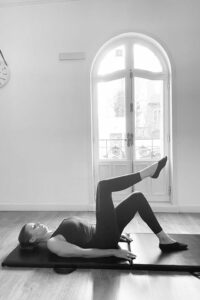
- Important. We must aim to move only the leg in isolation, so, even though it may seem easy to you, do not be complacent, as We must not move the back or pelvis at all.. Furthermore, it is essential that as you raise or lower your leg, you concentrate on doing so from your abdominal area. Imagine a string connecting your navel to your knee and think about pulling the string to raise your knee while drawing your navel inwards and upwards.
- Precautions. It is important that your cervical spine remains aligned and elongated during exercise, so if you need to, you can place a small cushion to help it remain in the correct position.
5-10-15
Maintaining the basis of the previous exercise, we draw the navel inwards and upwards, feeling the back stable on the mat. Without moving it, and without moving the pelvis, We extend one leg to the height of the knee of the leg that remains supported., so that we will keep the leg slightly rotated outwards and close to the other leg. We will hold this position for 5 seconds. Then we lower to the middle of the supporting leg's shin, holding for another 5 seconds, and immediately we lower the leg again to hold it above the ankle for another 5 seconds.
We go back up to knee height to do the same., this time for 10 seconds and, finally, we will repeat the entire process again, holding for 15 seconds in each of the three positions.
Once the final round has concluded, We raise the leg again to knee height with the supporting leg to bend it and rest the sole of the foot on the mat. Repeat the whole process with the other leg.
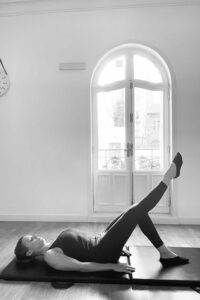
- Important. Concentrate on thinking that you are holding the leg from your powerhouse the centre of power, formed by both the abdominal zone and the pelvic musculature, therefore, you should maintain the previously explained gesture of drawing your navel inwards and upwards, as well as holding at hip level, thinking of “wrapping” them, gently contracting your glutes. Furthermore, It is fundamental that you think about applying force by trying to lengthen the leg. to avoid generating too much tension in the groin area and to avoid tensing the hip flexor muscles.
- Precautions. Try not to lock your knee. Your leg should remain straight, but you shouldn't create tension in the joint, so make sure not to hyperextend it. If you get tired You can always do the rounds by alternating one leg and the other. until you gain strength. If you have any discomfort or back pain, make sure to keep it straight. To avoid any of these sensations and do only the first two positions, without lowering to the ankle position.
Roll down
Sit down with your feet resting on the mat and together. Keep your glutes as close to your heels as possible and grip the back of your thighs so your elbows stay up. Position your shoulders directly over your hips, and applying the same concept of drawing your navel in and up, Think of your spine as if you want to create space between your vertebrae. and as you exhale, slowly articulate backwards, straightening your elbows, always keeping your hands in the same place. Once they are completely straight, Roll back up, exhaling and trying to mobilise your vertebrae one by one.. Repeat this exercise 5 times.
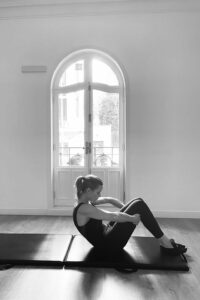
- Important. We normally do this exercise with a strap around the feet as an aid. If you practise it at home Can you put your feet under the sofa or of an element that helps keep them firm. You can protect them with a towel. Always think about performing the movement slowly and use your abdominal and hip strength to do it in a controlled manner.
- Precautions. If you have discomfort or pain in your back, do not do this exercise.
Simple stretch
Lying down, Bring both knees to your chest and hold your right leg with both hands, so that your right hand goes to your ankle and your left hand to your knee. Extend your other leg towards the ceiling and, keeping your back completely supported by drawing your navel in and up, Raise your head, directing your chin towards your chest and your gaze towards your navel., lifting your upper back off the mat to the tips of your shoulder blades.
The exercise involves alternating legs without lifting the back or pelvis, so that We will always take the leg with the hand on the same side at the ankle and the hand on the opposite side to the knee., while the other leg extends towards the ceiling, with the heel directed towards the centreline of the body, avoiding locking the knee. Alternate one leg after the other Do 10 repetitions with each leg.
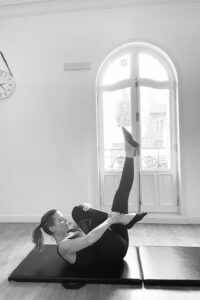
- Important. Practise this exercise thinking that the strength of your leg comes from your hip and not your knee. Each time you bring a leg to your chest, try to direct your knee to the midpoint between your shoulder and your ear. From that side to keep the alignment with the hip and avoid lowering the leg you're stretching too much so the back doesn't lift off. This exercise also works on coordination., but if you find it very difficult at first, you can grab behind your thigh with both hands.
- Precautions. If you get tired holding your head up, lower it and continue the exercise with it supported. Don't strain yourself and remember that As you gain strength, you'll be able to do more repetitions while lifting it.. In case of neck pain, do not lift it during exercise at any time and place a cushion to help align its position.
Double stretch
With both legs bent towards the chest, place both hands on the ankles., so that by keeping our heels together and the tips of our feet slightly apart, we try to bring the heels as close as possible to our glutes and our knees towards our chest without lifting our pelvis off the mat. Keeping your back straight, pulling your navel in and up, raise your head, directing your chin towards your chest and your gaze to your navel, lifting the upper part of your back off the mat up to the shoulder blades.
Stretch your arms and legs towards the ceiling as you inhale And exhale, bringing your legs back up as you make a circle with your arms in front of your field of vision to return to the starting position. Repeat 10 times.
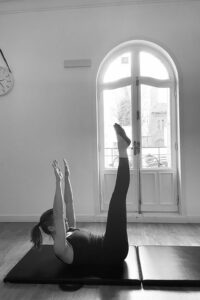
- Important. This is also a breathing exercise, so pay close attention to your breathing and try to expel all the air from the lungs when flexing legs to your chest. Try, each time you straighten your legs, Maintain a slight rotation of the hips, directing the toes outwards, with the heels kept together and the legs squeezed tightly. Watch your shoulders as you raise your arms and try not to tense up. If you find it very difficult, you can skip the arm circle and grab your legs directly.
- Precautions. If you get tired keeping your head up, lower it and continue the exercise with it supported. Don't push yourself., As you gain strength, you'll be able to do more repetitions. lifting it. In case of neck pain, do not lift it during exercise and place a cushion to help align its position. If you have any Ache or pain in any of your arm joints or around the neck, avoid the circle and bring the legs straight up.
Knee raises
Sit on a fairly hard surface, ensuring that when you are seated, your knee is not higher than your hip. If doing this on a chair, do not lean back against the backrest and place both closed fists at the sides of your hips.
Keep your back completely straight and pull your belly button in. and upwards, squeezing your glutes and pressing with your fists and feet, trying to lift yourself but without lifting off the surface. Lift one knee and hold the position for 3 seconds ...before bringing your foot back to the ground. Alternate with the other leg and repeat up to 5 times on each.
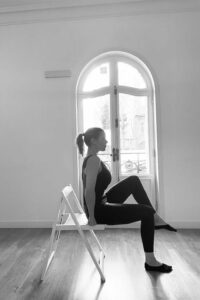
- Important. Be careful when lifting your knee not to shift to the opposite side. Ensure your back is straight and try not to lean back when raising your leg upwards.
- If the support of fists bothers you, you can, keeping your palm open and fingers straight, place it on the edge of the chair, pushing backwards so that your wrist stays straight, but without leaning on the seat and bending your wrist.
Circles on the wall
Stand, preferably barefoot, pressed against a wall so that you initially maintain contact with your heels (together with the tips of the feet separated in a “V” shape) and the back. Help yourself by resting your palms with your arms extended. In this position It would be ideal if you were able to paste your entire column., but you'll see that, especially in the lumbar area, it's complicated. Try, using the strength of your powerhouse, pull your navel in and up to try and bring your lower back closer to the wall and, without losing that strength, walk slowly forwards, taking small steps without leaning to the sides, until you see that your back is completely against it.
It is important that you maintain at all times the Pulling the belly button in and up to prevent the back from lifting. and, once your position is taken, remove your hands from the wall and place both arms stretched out in front of your thighs. Begin to inhale as you lift both arms in front of your shoulders until they are parallel to the floor. Open them to the sides and complete a circle by bringing them back down to the starting position as you exhale. Repeat 3 to 5 times and then change the direction of the circle, also repeating 3 to 5 times.
When you have finished all the repetitions, Place your hands back on the wall and try to walk backwards a little. keeping your back against it. You'll likely only gain a few inches.
With the help of arms, Push yourself away from the wall in one block and hold the position for a few seconds.. Keep your navel drawn in and up, and your spine in a straight line. Feel the weight of your body slightly towards your toes without lifting your heels and keep your arms relaxed at your sides. Walk trying to keep your core strong and imagining you have a wall stuck to your back.
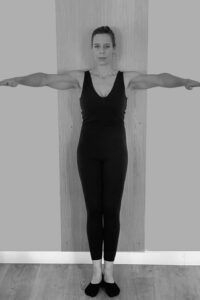
- Important. Remember that the most important thing is that your back stays completely pressed against the wall. It's important that you don't lose the inward and upward strength of your navel and that you think that force is what makes you raise your arms and perform the circle. Try not to carry tension in your neck or shoulders During exercise, visualise yourself moving your arms from the sword. Avoid locking your knees during the exercise, and Keep your legs straight, but try not to hyperextend them to avoid pressure.
- Precautions. Do not perform the circles if you feel discomfort in your neck or shoulders. You can raise your arms only to shoulder height and then lower them, as long as this does not cause you any discomfort. In case of back pain, it is not advisable for you to do this exercise. If there is no pain but you typically suffer from back tension, you can modify your foot position by splaying them slightly and placing them parallel.
Tell us what you thought of this article, please rate it (1 TO 5 STARS).