
Our body, day by day, is constantly readjusting to keep itself balanced. These adjustments are usually small and almost imperceptible, as our daily movements are not usually abrupt. But what happens when we receive an impact or are subjected to prolonged positions that affect our body alignment?
In this article, we explain the domino effect that imbalances have on our body and how compensations occur that can lead to injuries. We also explore the importance of postural correction in Pilates to restore balance and prevent future problems.
Influence of impacts on our body
When we receive an impact or are faced with an inappropriate posture, our musculature acts to counteract the force that causes the imbalance. If this force is intense or sustained over time, it can produce a fixation, i.e. a limitation of movement in a joint. The body, in its effort to adapt, generates compensations that produce a misalignment, affecting other joints and reducing the effectiveness of the movement.
Consequences of inefficient movement
Imagine two perfectly aligned pieces of metal sliding smoothly. If one of them loses its position, the movement becomes less efficient, generates friction and eventually the parts wear out or break. The same thing happens in the human body. When a joint does not move properly, the constant friction between the bony surfaces causes damage to protective structures such as cartilage, menisci or intervertebral discs.
And as this is a cascade reaction, because we are always in a constant search for equilibrium, this phenomenon will follow one after the other.
FIXATION → COMPENSATION → MISALIGNMENT → INEFFECTIVE MOVEMENT AND INCREASED PRESSURE → INJURY
When does a fixation occur?
A fixation occurs when a muscle contracts and stays in that position for a long time. A clear example is in high-impact sports, where the muscle contracts quickly to protect the body. However, the same can happen in everyday situations, such as when we spend long hours sitting at the computer. In this scenario, the shoulders and head tend to project forward, and the musculature involved gradually shortens, causing the same consequences as mentioned above.
Pilates as a tool for correcting posture and improving mobility
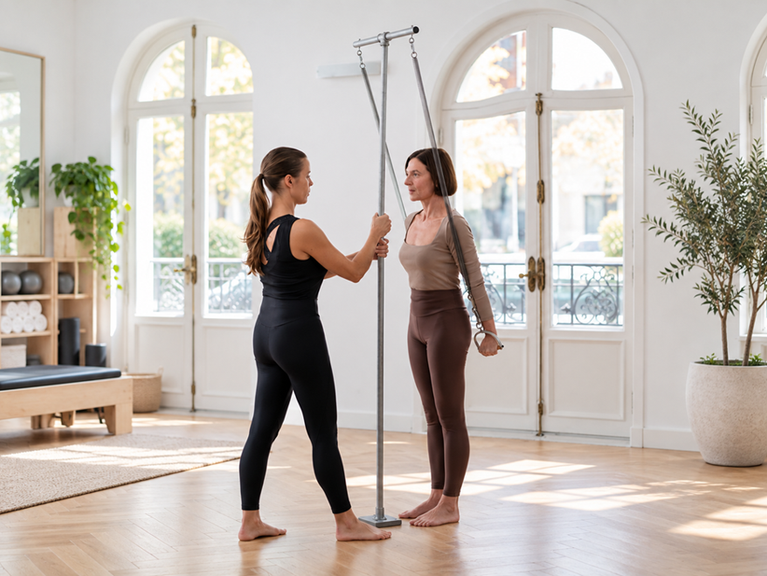
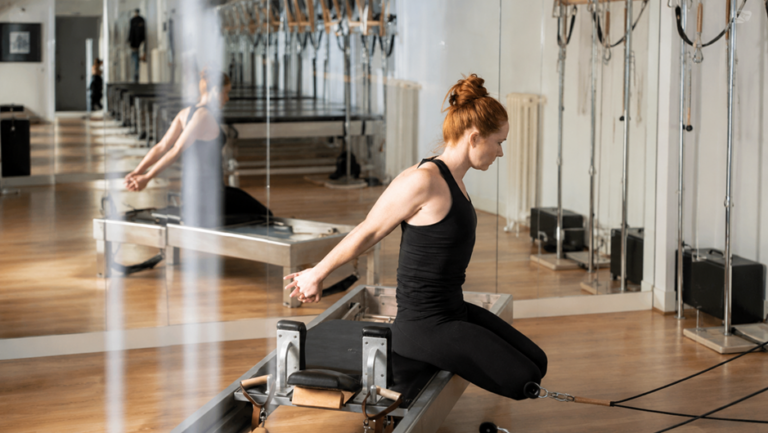
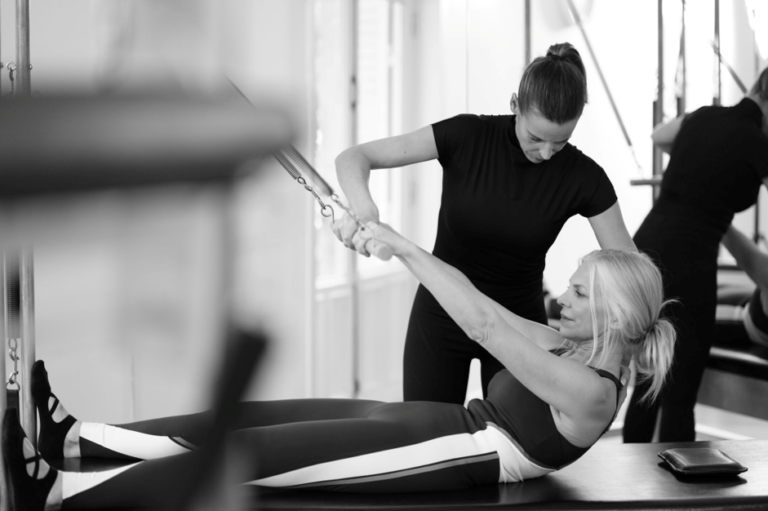
To address an injury, it is not enough to focus on the pain, but it is essential to act on the cause, i.e. the fixation. This is where postural correction in Pilates plays a key role. That is why, in our Pilates classes in Madrid we work in a global way, restoring the correct mobility to the body, releasing the muscular fixations and realigning the joints.
By restoring proper alignment through Pilates exercises, pressure on the joints is reduced and movement efficiency is improved, which in turn relieves pain and prevents future injuries.
Postural correction in Pilates is not only essential to regain mobility and prevent injury, but also to restore balance to the body. If you feel that your movements have become inefficient or you experience recurring pain, consult a Pilates practitioner who can help you identify the fixations and compensations in your body, and begin to work on restoring your alignment and mobility.
Tell us what you thought of this article, please rate it (1 TO 5 STARS).