
In the pilates class, Using the mat and specific apparatus, we will work on the exercise programme devised by Joseph Pilates, which focuses on realigning the body structures and readjusting the muscle chains with control from our centre, strengthening the deep musculature and in coordination with our breathing, with the aim of achieving and improving the functional qualities that the body needs for our movements to be effective and efficient, without hurting ourselves, gaining strength, flexibility, coordination or balance and always looking for the quality of the movement with the least possible expense, in order to obtain a good physical and mental state and have a good quality of life.
What are the fundamental principles of Pilates?
The method that Joseph Pilates designed is based on 6 fundamental pillars which are the basis for each exercise and its execution within the programme, and which are essential for understanding and practising it. These are: “Energy Centre”, “Breathing”, “Concentration”, “Control”, “Precision” and “Fluidity”.”
What types of Pilates classes are there?
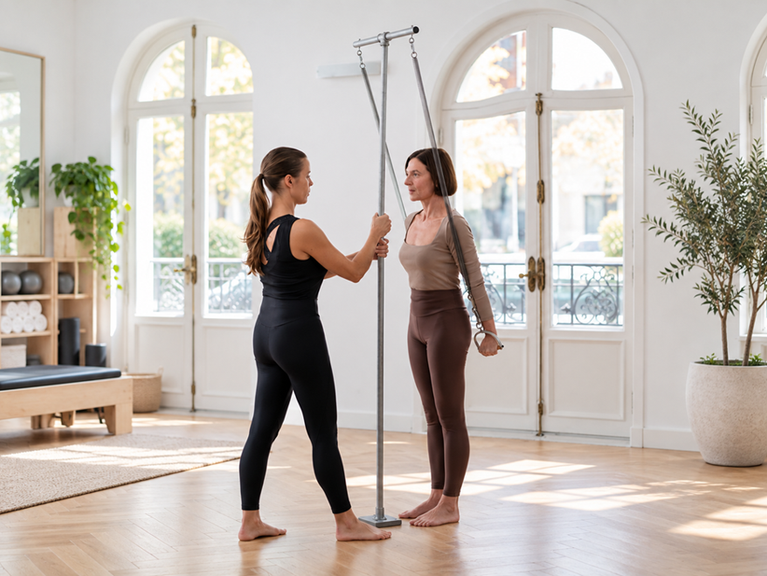
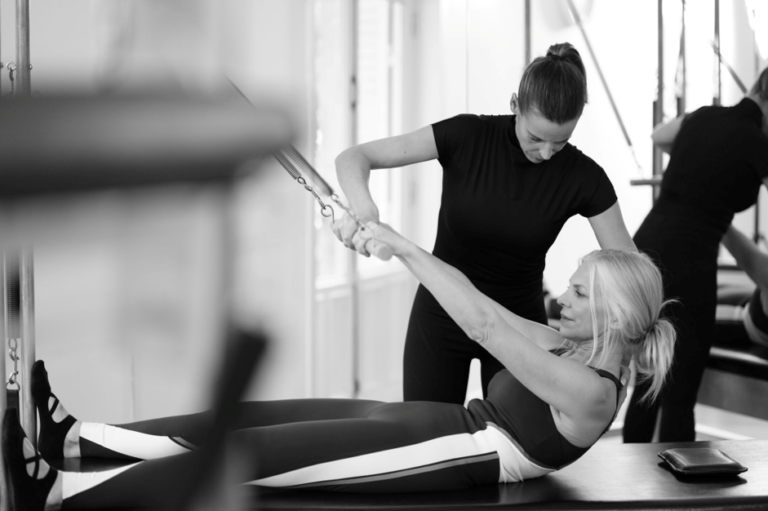
In the first classes as a beginner, the teacher will make an initial assessment to establish the needs and adapt and modify what the person needs to prevent any damage or injury. From there, during the course of the class, the physical qualities and characteristics of the person, their deficiencies, weaknesses and decompensations will be highlighted and they will work on them to improve their physical conditioning and functionality.
The classes will progress in different levels according to the demand and control that we acquire, and determined by the mastery of the objectives set by the exercises that we overcome at each level. As the exercise programme progresses, we will achieve control of movement, strength, resistance, coordination and balance.
All classes are developed on the basis of the same principles, from which “Contrology” draws to develop its benefits. These are:
- Energy centreThis is the motor from which the strength to the rest of the body comes from. It comprises the area between the lower ribs and the lower part of the hips, like a girdle that surrounds the abdominal, lumbar and gluteal area.
- ConcentrationNecessary for the mind to become aware of its capabilities, limitations and weaknesses, coordinating its movement with the breath, maintaining control and improving its state.
- ControlNothing happens randomly or haphazardly, but all movement is controlled.
- AccuracyExercises should aim for perfection in the correct execution, giving quality of movement and achieving the proposed objective.
- Fluencycarrying out the exercises in a harmonious and natural way, without sudden movements or impacts that disturb the function of the body.
- BreathingBy making the air enter and exit naturally and deeply through the nose and taking it to the intercostal area to fill the lungs with air, increasing their capacity and also favouring blood circulation.
What is the typical structure of these classes?
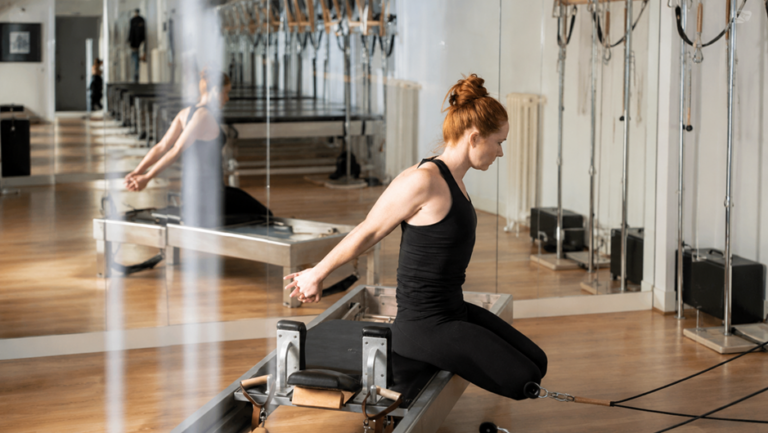
Generally, a Pilates class begins with the Reformer. This is the most important apparatus of the method and the one with which, whenever possible, except in cases of pain or injury, we will start the session.
The reformer helps, through its design and its spring system, to align our body, to balance the supports and loads and to help us to find the correct musculature and to work on the different exercises, not only their toning, but also their elasticity.
The second part of the class focuses on mat work. This is another part of the system to work on. It is fantastic for helping us to strengthen our energy centre and in general the whole body, as in this case, there are no external aids such as the reformer. That's why the mat is considered a challenge and the ideal thing to do is to practice the exercises on it once you've done the routine on the reformer.
A third part of the class is devoted to to carry out more specific work on those qualities or parts of the body that each person needs to strengthen the most. We use the rest of the equipment in the system, which is used for more analytical work at the end of the session and complements all the previous training on the reformer and the mat.
Among the rest of the devices we find some very well known ones such as the Cadillac, the chairs or the barrels, but also some less known ones such as the Pedi pole, the finger extension or the foot corrector.
Common exercises in Pilates classes
All the exercises are essential and very necessary for beginners as well as for more advanced levels. All of them will be introduced as the strength and control of what we consider in the method the main and most important objective, which is to strengthen the Powerhouse or “energy centre”, as from this strength we will be able to work on the functioning and movement of the body, achieving, among others, some very necessary objectives such as:
- Articulating the spine and making it more flexible, as in “Roll up”, “Teaser” or “The Saw”.” on the mat and in “Hug” o “The tree”The “Snake & Twist” in the Short Box series or the "Snake & Twist" in the Reformer.
- Working on breathing, as the “Spine stretch forward” o “Double leg stretch”on a mat, or “Hundred”, “Coordination” or “Swimming backstroke” in reformer.
- Strengthening the rib cage and stabilising the shoulder girdle, as with the exercises in “Baby chair”, “Baby chair", "Baby chair", "Baby chair" and "Baby chair".“Rowing series”.” in reformer, or “Arm springs” in Cadillac.
- Strengthen the hips and the whole muscle chain towards the legs., as in “Leg springs”in Cadillac, “Pumping”in “Electric Chair” or “Elephant” in reformer.
- Alignment and balance, as “Teaser” o “Splits”in reformer, “Going up front”in “Electric Chair”.
Each class will be adapted to the person depending on their physical characteristics and needs, and depending on the level they acquire, the exercises will progress in order to challenge the strength of the centre and to achieve much more control, extending ranges of movement with more strength and with good joint stability, greater flexibility in the spine, better alignment, with more balanced muscle chains.
What are the main benefits of Pilates?
We can establish a series of benefits that will appear from the first work sessions:
- Fortalise the energy centre, The abdominal, lumbar, pelvis and hips, from which all body movement starts.
- Works on joint stability by strengthening the internal musculature.
- Great spinal mobility work in all its planes and actions and strengthening of its musculature.
- Improved strength, flexibility, balance and coordination of the whole body as a whole
- You will improve your body awareness. You will start to notice how your body works and get to know what your strengths and weaknesses are. It will be much easier to balance them.
- It will increase your concentration and mental control, in exercise as well as in everyday life.
- Reduces stress and boosts self-esteem. This concentration will allow us to focus on ourselves and to be able to channel the work of the mind in a serene way.
- You will get better rest. After your class, the body will release endorphins that generate a state of well-being that induces sleep and makes you sleep better.
- Improve breathing and blood circulation. Your lung capacity will increase and your gestures in daily life will make you less fatigued and less tense the muscles that normally contract.
- You will adopt healthier postures. The global work of the entire musculature leads to a lengthening of the spine and thus to a more upright posture, realigning and readjusting structural decompensations, thus improving postural hygiene in your daily life and at work.
- You will walk in a more fluid, efficient and natural way., This is because your body will learn to economise on strength and will be able to be more balanced.
- Work on the rehabilitation of injuries, It is also a good way of restoring function, even in the early stages, and helps to prevent the development of new lesions.
- Ideal as complement to other sports, The performance is improved.
Frequently asked questions
What do I need to bring to my first Pilates class?
You will only need comfortable clothes that allow you to move your limbs widely, and if possible, not too wide, to avoid folds or seams that bother you. Also, it will be easier for your teacher, who will need to see your silhouette and alignment.
Also note that you will do the class barefoot or in socks, to improve the sliding of your foot, but with stability.
How often should I attend Pilates classes to see results?
This may depend on the circumstances of each person. Generally, 2 sessions per week is recommended, especially if you are a beginner. However, if you can only attend once a week, the most important thing is to maintain a routine and consistency so that your mind and body can remember the exercises and integrate the teachings. It is most beneficial if there is not too much time between sessions so that the learning process can take hold more quickly.
Can I do Pilates if I have back problems or previous injuries?
One of the important characteristics of the method, which differentiates it from other physical disciplines, is that it can be performed by any type of person with practically no contraindications, whether a healthy sportsperson or someone who has a pathology or has suffered an injury or has to recover from it. In these cases, we have the possibility of introducing modifications within the exercises themselves and the sequences of the series to work on them and improve them without putting at risk any structure that may be affected.
Tell us what you thought of this article, please rate it (1 TO 5 STARS).