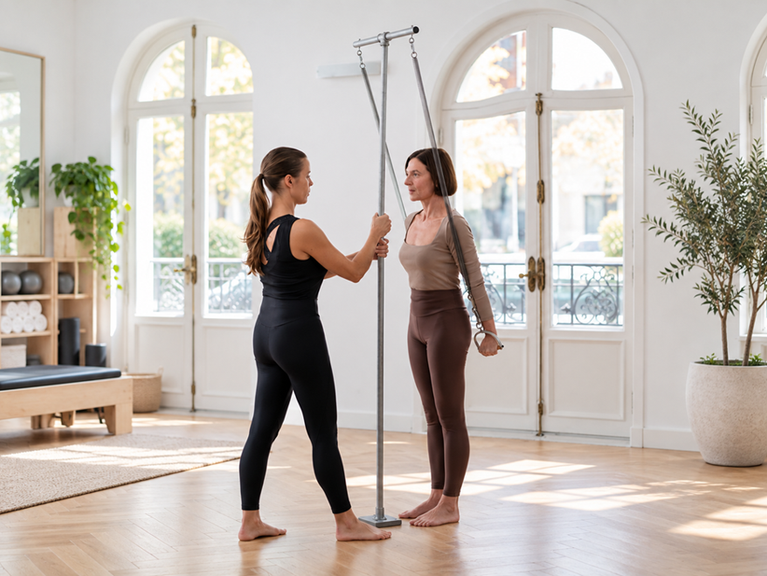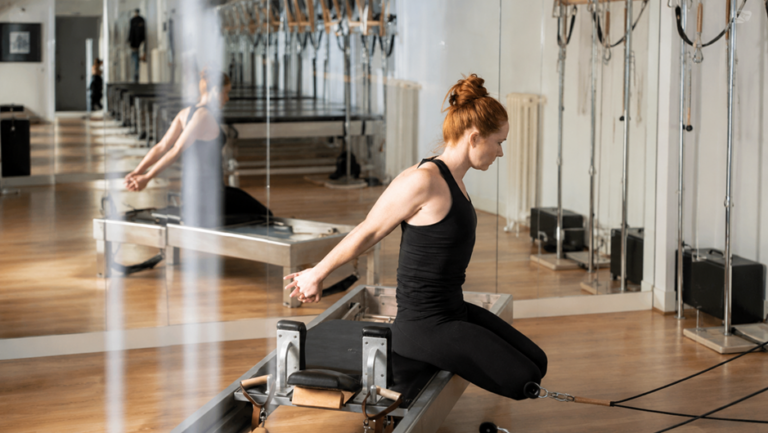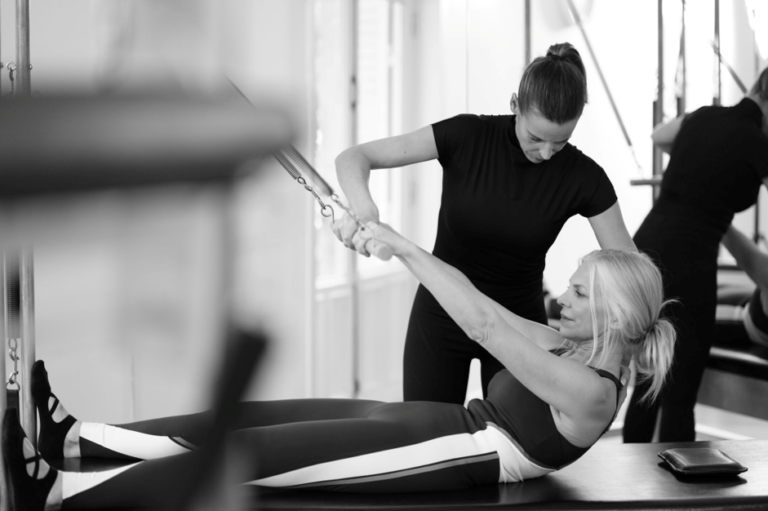

Today we would like to focus on the most common ailments in this area of the body and their most effective treatments. The shoulder is a structure composed of a complex of several joints and requires a more demanding biomechanics, so it is very common that any pain or pathology that affects, by instability or weakness, this structure may appear. This is the reason why physiotherapy and Pilates work is essential to rehabilitate it. Among its various ailments or pathologies we find the following:
- Subacromial impingement syndrome. This is caused by a narrowing of the space through which the supraspinatus tendon passes, which becomes compressed and starts to become inflamed, causing pain and limitation of movement of the arm above the shoulder with loss of strength. If it does not stop, it can end in rupture.
- Rotator cuff tendinopathy. The rotator cuff is made up of several muscles that provide stability to the shoulder. If any one of them is affected, it will affect the function of the shoulder as a whole and cause pain. The tendon of the damaged muscle will go from inflammation to degeneration and may eventually rupture, causing a lot of pain and disabling movement. The same happens with the long head of the biceps, which can also suffer inflammation in the tendon.
- They are deposits of calcium crystals that can form in a rotator cuff tendon or bursa. They may be associated with acute inflammation and pain, although they can often be asymptomatic.
- Adhesive capsulitis or frozen shoulder. Caused by adhesions in the joint capsule and head of the humerus. Any movement of the shoulder causes pain, leading to stiffness that increases over time.
- Glenohumeral instability. It is associated with shoulder dislocation, which may be caused by trauma or by generalised hyperlaxity due to very weak muscles or excessive mobility.
To initially treat these pathologies with physiotherapy, we use techniques that help us to reduce pain or discomfort such as: electrotherapy, INDIBA, ultrasound, manual therapy and dry needling. With these we will normalise the muscle tone that is unbalanced and which causes the alteration in function. After this we will work on stability and mobility, to prevent stiffness and expand the space of the joint, without putting its structures at risk. In this aspect Pilates is key to be able to exercise our shoulder from the first moment of the injury. The method offers the possibility of making the necessary modifications to improve without pain and thus integrate it into the functionality of the rest of the body, always working on correct joint alignment and muscle stability. In addition, the springs and straps of its apparatus will assist us and resist the movement according to the objective we are looking for.
First, we will introduce exercises to stabilise the musculature of the shoulder girdle within the rib cage without forgetting to work on mobility, tone and flexibility of the spine and strengthening our core and internal musculature. Later and without pain, we will perform exercises on the apparatus that will help us to increase the range of mobility and flexibility of our shoulder.
If you suffer from any shoulder ailment, call us and ask us about your case. We can help you. Tel. 91 4357838. 628 887552. info@elitepilates.net
Tell us what you thought of this article, please rate it (1 TO 5 STARS).