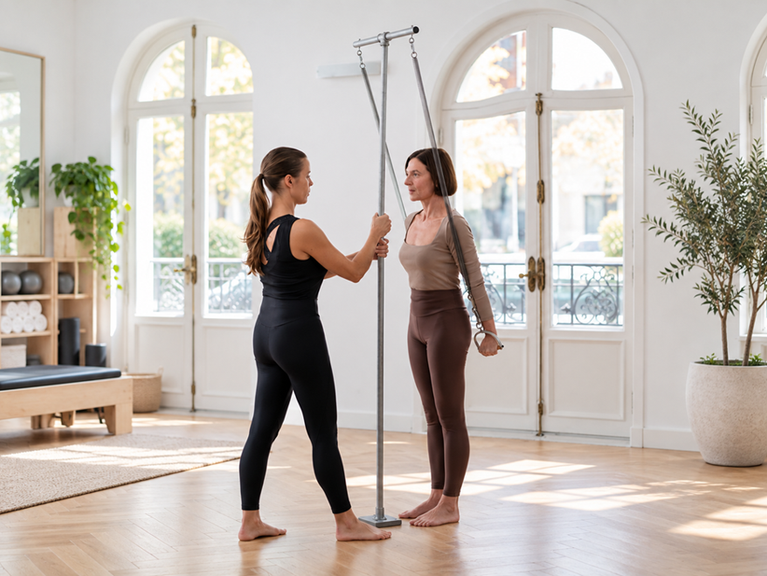

In recent years the Pilates method has become very popular, but despite the fact that it is supposedly becoming more and more well-known, there is a lot of misinformation about what it really is. That's why today we explain how a session with this system of exercises should be developed and we clarify one of the most frequent doubts: Pilates on the floor or with machines?
In a real Pilates session, it is necessary to use the different apparatus as well as the mat. Each part is necessary, but they must be practised in combination, as the result can only be achieved with the combination of all the parts.
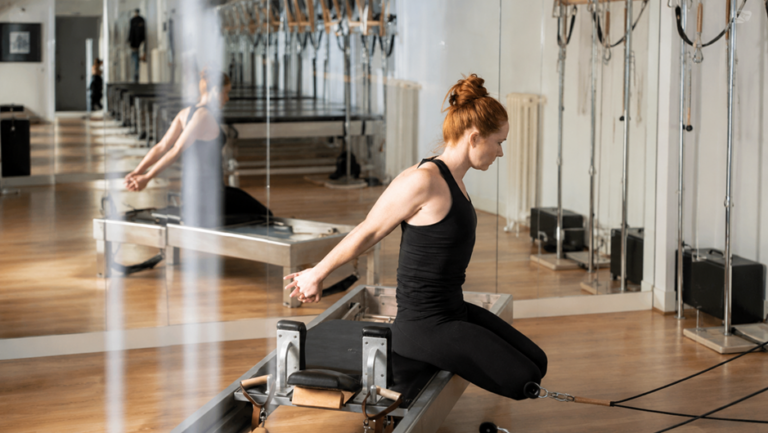
Pilates with machines: The reformer is the base
This is the main apparatus of this technique and the most important one, because it provides the basis on which we will later have to work with the rest of the system. It helps the person, as its name suggests, to “reform”. That is to say, it provides us with work aimed at correcting alignment, while at the same time helping us to find the correct musculature necessary to work on each exercise, providing strength and flexibility. This is achieved thanks to its spring system and the characteristics of its design.
Advantages and disadvantages of Pilates with machines
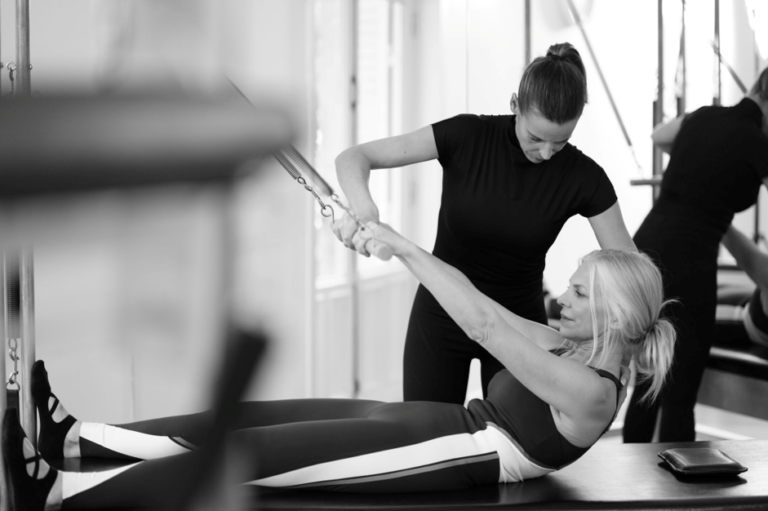
Compared to Pilates on a mat, which can be practised at home, Pilates on apparatus offers several advantages, such as a greater variety of exercises, adjustable intensity and personalised attention from professionals. Experts point out that the use of apparatus in Pilates enriches the repertoire of exercises, making them more varied and stimulating.
However, there are disadvantages to Pilates with apparatus compared to Pilates on a mat at home. For example, the equipment requires more space and is more expensive, which increases its price and makes it only available in specialised centres.
Pilates on the floor: mat only as much as necessary
The mat is necessary, and everyone should use it every session after the exercises on the reformer, as it provides a greater challenge and helps us to strengthen much more. However, this part of the controllology is neither too much nor too little, it will simply be determined by the characteristics of each person and their needs. This is why we usually only give each client the best exercises for their body type in a session.
Advantages and disadvantages of floor Pilates
Compared to Pilates on machines, Pilates on mats offers significant advantages in terms of accessibility and cost. It is more affordable and readily available, as Pilates classes on machines are usually only available in specialised centres.
Regarding the limitations of Pilates on matt, it may not be as effective for rehabilitation exercises, due to the absence of the springs of the machines that assist in the execution of certain movements.
So, floor pilates or machine pilates?
After considering the strengths and weaknesses of each variant of Pilates, the question arises: which is better, Pilates on the floor or with machines? The truth is that it would be most beneficial to combine both forms of Pilates. In addition, before starting on machines, it is crucial that practitioners master the basic principles and fundamental body movements on the floor.
Machine Pilates is particularly advantageous for people with body stiffness, as the springs assist in muscle stretching through eccentric work. On the other hand, mat exercises are more beneficial for people with more laxity in their bodies, as these exercises encourage the development of stability.
Importance of choosing a real contrology study
Since both the equipment and the mat are necessary for each session and must be combined according to the needs of each person, there are two essential factors that must be taken into account when choosing the right Pilates centre:
- On the one hand, it must have all the equipment that exists and that was created by Joseph Pilates in order to be able to offer as many possibilities as there are typologies.
- On the other hand, teachers must have a complete and deep knowledge of the whole system. A teacher is not a teacher who only knows some of its parts independently, because in order to achieve results, and going back to the beginning, these will only be achieved with the sum of the parts.
Tell us what you thought of this article, please rate it (1 TO 5 STARS).