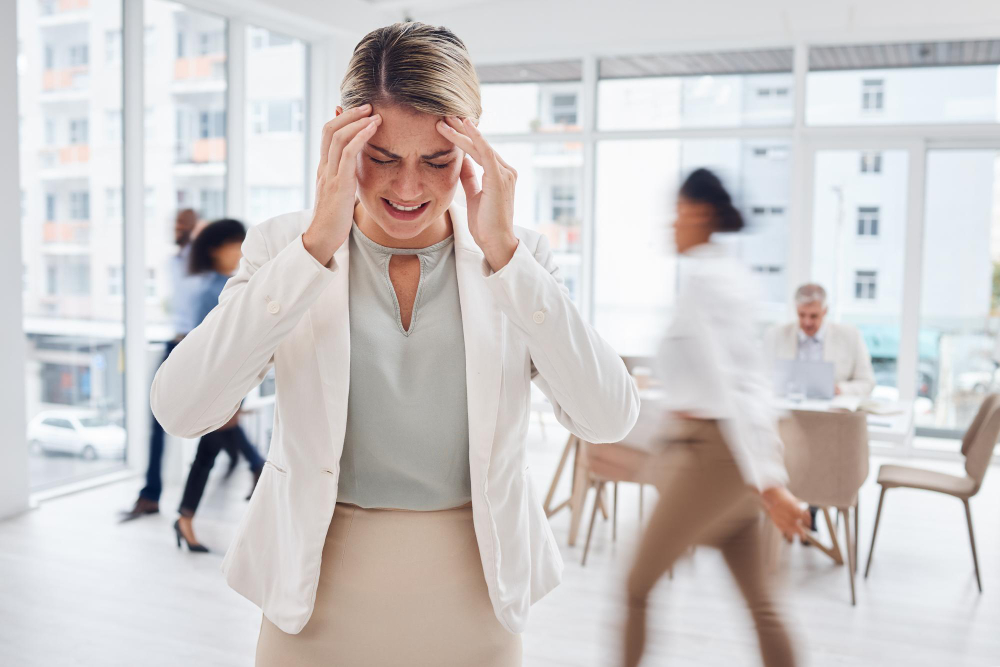
Impact of Job Stress on the Body
Work-related stress is a serious problem that affects our physical and mental health. A person with high stress at work will perform less well, will be less productive and will end up suffering from different health problems.
It causes chemical changes in the body in a constant “fight or flight” mode, being responsible for many diseases involving the nervous, circulatory, endocrine, digestive or musculoskeletal systems.
Physical effects of prolonged stress
Work overload, pressure to meet targets and deadlines, the working climate and conflicts between staff, job insecurity or lack of control and autonomy are all factors that end up affecting our health.
Some problems could be:
Muscle contractions: due to constant involuntary over-voltage, especially in the neck or back muscles.
-Changes in breathing: using shallower breathing, which makes more use of the neck and shoulder muscles rather than the diaphragm and intercostals.
-Cardiovascular system: increased blood pressure and increased risk of heart disease.
-Gastrointestinal disorders: nausea, irritable bowel syndrome and other digestive problems.
-Consequences on mental health: difficulty concentrating, anxiety, depression, Burnout Syndrome or physical and emotional exhaustion at work,
dizziness or lightheadedness, sleep problems, fatigue, exhaustion, difficulty concentrating, shortness of breath, sweating, increased heart rate, skin problems such as eczema.
In the long term, cardiovascular or gastrointestinal problems may also arise.
How stress affects posture and musculature
Many everyday ailments or dysfunctions are caused by the positions or postures acquired over hours during the working day.
For example, in an office environment, concentration in front of a computer screen while sitting for hours on end, combined with a lack of rest between periods of time, can lead to stooped postures, with shoulders and head slumped forward, causing weakness and lack of strength due to muscle fatigue, stiffness, limited mobility, hip pain, or numbness or tingling in the arms or legs.
If these postures persist over time, the muscles become even weaker, stiffer and shorter, limiting the mobility of the joints and causing pain and pathologies such as back pain, cervical pain, dizziness and headaches, sciatica, tendinopathies in the shoulders, elbows or wrists.
Also, during the night's rest we may find ourselves with tense muscles due to stress, sleeping in strange positions, with bent wrists, clenched fists, or with the jaw and neck under tension.
Benefits of Pilates to Combat Workplace Stress
Reduction of muscle tension
The Pilates method is a key discipline for the development of body awareness and self-knowledge. It helps us to feel each part of the body being able to dissociate movements, forces and establish an exquisite control of each structure.
This makes us concentrate and identify what is unnecessarily tense so that we can work on it, relax it and stretch it, removing stiffness from the joints and increasing their flexibility.
Improving emotional well-being through breathing
By working together with our concentration and deep and conscious breathing, we will oxygenate the tissues and our body will release tension where it is not needed, relaxing the muscles and acting directly on the physical, psychological and emotional stress that sometimes causes psychosomatic pain, which will also be reduced.
Pilates Exercises for Reducing Stress
The whole Pilates exercise programme will help us to achieve good physical health and a balanced mind by lowering cortisol levels and reducing stress.
Physical and mental wellbeing will change the way we perceive other areas or aspects of life that worry us or have a negative influence on us, transforming it into a more positive way of thinking and personal growth.
Breathing techniques to relieve anxiety
There are several breathing techniques which, although not all of them are suitable for use in the method, can be used as a complement to help calm the nervous system and reduce body and mental tension, even at work or at home.
Techniques such as:
–Diaphragmatic breathingThis is the abdominal or lower breathing. With one hand on the chest and the other on the abdomen, inhale slowly through the nose, raising the abdomen and keeping the chest still; hold for a few seconds and exhale through the mouth, emptying the air and lowering the abdomen. Repeat for 3-5 minutes.
–Square breathingInhale through the nose for 4 seconds; hold the breath for 4 seconds; exhale through the nose for 4 seconds and hold the breath again for 4 seconds. Repeat this cycle several times.
–Physiological sighInhale slowly through the nose; then inhale a second time, filling the lungs completely; and exhale slowly through the mouth.
It is important to know that in Pilates the breathing is not abdominal, In this breathing pattern, the muscles of the abdomen relax and we would lose the strength of the centre, leaving the lumbar region very unprotected. intercostal breathing, filling mainly the lower part of the lungs (lateral and posterior lower ribs), which is more flexible and has more capacity to store air while strengthening our core. It will be through the nose, in a fluid, natural, rhythmic and noiseless way.
Gentle movements to release accumulated tension
In this method we make the body work with controlled and precise movements, focusing more on the quality than on the quantity of repetitions, focusing our attention on knowing and self-controlling the body. It will make us work more on our body awareness, identifying areas of unnecessary tension and focusing on those that need to be strengthened.
We will exercise the body in an integral way from our energy centre to the extremities and from the deep and internal musculature to the external, strengthening and flexibilising the whole body as a whole with a suitable rhythm, smoothly and fluidly, without overloading, reducing muscle fatigue, joint stiffness and accumulated tension.
Pilates and its Impact on Mental Health
Relaxation and mental concentration
Thanks to the great work of concentration that the method requires, we achieve exhaustive control, becoming aware of every millimetre of our body and obtaining very precise movements. This will not only help us to improve our physical condition, but also our mental control.
The mind needs to have challenges that require the development of skills. The more complex they are, the more concentration is required. By focusing on the task at hand with our body, it is more difficult for our mind to dwell on worries and fears.
Knowing how to control it, in addition to our breathing, will help us to reduce stress and anxiety levels, calming the mind and thus also improving the quality of sleep, forgetting our daily burden and problems. It promotes rest and relaxation and, as a consequence, improves the quality of life of the person.
Emotional balance and stress management
There is a work of coordination of movement with breathing that helps us to connect the body with the mind, thus aiming to bring full attention and focus on the here and now, providing a greater benefit in emotional regulation.
Achieving objectives and obtaining results will make us connect with the emotion, value the effort and the learning developed. Endorphins will be released, which will improve mood, self-esteem and the feeling of well-being and euphoria, relieving the symptoms of stress.
It will help develop greater awareness of emotions and physical reactions, identifying them and facilitating their regulation.
Pilates in the Office: Short Exercises for Work Stress
In addition to working on the keys to the method in sessions with a professional, it is also good to apply the fundamental concepts in other everyday spaces such as the workplace. We may not be able to get down on the floor with a mat or use specific equipment, but in many cases, simply by doing some exercises on a chair, or leaning against a wall and using our core strength correctly, we can develop a pattern of exercises that will improve and alleviate poor posture or overload in the workplace.
Neck, shoulder and back stretches
TV Box- Sitting on a chair, with the back and neck upright, we perform neck movements with rotations, bends and flexions, shoulder and arm movements, and even leg movements, drawing the strength from the Powerhouse. It will lengthen and relieve the muscles of the neck, shoulders and back while we gain strength in our core.
Wall Exercises - With the spine resting completely against the wall, keeping ourselves stable from the strength of our Powerhouse We will perform movements of the arms, spine and legs, relieving lumbar overloads and working the back muscles.
Relaxation techniques during the working day
Deep breathingBreathing in this way helps to oxygenate our blood and relax both body and mind. It is one of the keys to relaxation.
Take 3-second inhalation and 6-second exhalation breaths, bringing the air into the lower part of the lungs, with 1 second in between holding the air.
Imagining how air enters the lungs and is distributed in the lungs helps to concentrate and escape from stress.
Progressive muscle relaxationIt allows us to identify the sensations of tension and relaxation. It consists of putting tension on a specific muscle group and then voluntarily and consciously releasing the force and finding relaxation in the muscle. It can be combined with deep breathing.
StretchingIt will help to relax the muscles and release tension.
Take short breaksHow to get up, walk around and change the environment for a few minutes to disperse the mind.
When and How to Do Pilates to Combat Stress
The practice of the method guarantees us, in each session, to become aware of our body and mind, controlling and dominating the structures that need to be strengthened and rebalanced. It will allow us to focus the mind on what we want to focus on and remove tension from what does not need it, so a good training routine is important to maintain the results.
Recommended frequency for stress relief
With constant and continuous training of the method, we can make the body perform its daily functions efficiently. We will move better with much less effort. It is always advisable to do a couple of sessions a week, if possible, with alternate rest days, and with good nutrition.
It is the fundamental basis for Pilates to be a safe method with full guarantee of short and long term results for any type of person, of any age, morphology or physical condition.
The ideal time of day to practice Pilates
The best time to practise Pilates will depend on the individual, their availability of time to establish a routine and their lifestyle and personal preferences.
There is no single ideal time to practice it, but some times may be more beneficial.
In the morning will help you start the day energised and focused, activating body and mind.
Afternoon or afternoon/evening will help to release tensions that have arisen during the day, facilitating a better rest. In addition, during this period the body reaches its maximum body temperature, which helps to improve muscle and joint function.
Other Benefits of Pilates in the face of Workplace Stress
Among other benefits, the method, in the face of stress at work, gives us greater body awareness and mental control, better rest, increased self-esteem, and a multitude of physical benefits that will help us productivity and performance.
Improved posture and reduction of back pain
-Improves body posture, realigning and readjusting structural decompensations, thus improving postural hygiene during daily activities.
-Strengthens the energy centre and thus the rest of the musculature.
-It works on joint stability by strengthening the internal musculature.
-Great work on the mobility of the spine in all its planes and actions and strengthening of its musculature.
-Increased flexibility of the whole body as a whole.
-Improves balance and coordination.
-Improves the fluidity and efficiency of walking.
-Improves breathing and blood circulation.
Increased energy and concentration at work
With the practice of the method, in addition to maintaining full attention on the functioning of our body, focusing on the here and now, we train our brain to be able to allow the passage of those stimuli that are relevant to what we are interested in at that moment and block distractions.
Increase vitality, work performance, energy level, daily productivity, improve mood, general well-being and our health.
Frequently Asked Questions:
What are the best Pilates exercises to relieve stress?
All the exercises of the method, both on the mat and on the apparatus, help to increase the ability to concentrate and work on synchronising the breath with the movement, connecting the mind with the body, improving mental clarity and relieving stress.
Can Pilates help improve work productivity?
Achieving physical and mental wellbeing, with the practice of the method, will change the way we perceive other areas, such as work, transforming them into more positive thinking and personal growth, identifying unnecessary tensions that we can manage and balance so that they do not interfere in our daily lives, improving performance and productivity.
Do you need to be a Pilates expert to start reducing stress at work?
The practice of the method offers us full guarantee of results in the short and long term for any type of person, of different age, morphology or physical condition and it is not necessary to be an expert from the beginning to start noticing the changes in terms of stress reduction along with other objectives and benefits that the method brings us.
Simply by constant and continuous training, we can make our body and mind change and progress to perform their daily functions efficiently. With much less effort and expense, we will feel better and better, with greater performance and well-being.
Tell us what you thought of this article, please rate it (1 TO 5 STARS).