
Impact of Bad Posture on the Body
Acquiring bad postures throughout our lives leads us, on a regular basis, to suffer muscular imbalances and overloads which, over time, become dysfunctions and pathologies such as back, neck and lumbar pain, herniated discs, sciatica, headaches, vertigo, dizziness, pain irradiation, tingling in the arms and legs, knee or hip pain, tendinopathies and even respiratory problems.
The spine is one of the most important structures and conditions the position of the body in space and the distribution of its loads. The cervical and lumbar spine are the most fragile areas of the spine as they are designed to carry out a large number of movements throughout the day. In addition, all the nerves that go to all the body structures pass between the vertebrae. That is why any structure that loses its position and moves, will cause us to acquire inadequate postures that, lasting over time, will cause pain, compression, wear and tear or lack of mobility.
The same happens with the rest of the joints that support weight or pressure and become weak, causing muscle tension, inflammation of tendons, ligaments, or wear and tear of joint cartilage.
Why Choose Pilates to Correct Posture?
Working all the central musculature, and with it the whole spine, is essential to achieve a good posture and maintain it over time. If a spine is not healthy, the rest of the body will also be affected and will give us little warnings in the form of pain that something in our posture may be going wrong.
If our body is not strong, stable, flexible and balanced, it will have less resistance to maintain a good position for a long time. This is when aches and pains appear, which in the long term can develop into pathology.
With the Pilates method we work the whole body, from the strength of the “powerhouse” or “energy centre” (deep musculature) to the extremities, while strengthening and flexing the spine. We also seek, through concentration and awareness of the correct position of the joints, a good alignment, working on the exhaustive and precise control of the body.
In this way we manage to work the muscle chains in a uniform and balanced way, improving strength, flexibility, stability and mobility. All this helps to correct posture and improve physical condition, which is reflected in our daily life.
Postural Assessment in Pilates
Our body acquires postures conditioned by our life habits, work, or daily tasks. These postures are not always the most appropriate and, on many occasions, the muscle chains become unbalanced and cause misalignment in the position of the body. This will trigger the appearance of pain and injuries that will cause the body to acquire incorrect movement patterns which, in the long term, can lead to major pathologies.
The method aims to realign and readjust the muscle chains allowing for improved posture.
In order to intervene in the changes that we need to achieve, the teacher will make an initial assessment in which muscular imbalances and postural patterns that influence the overall functioning of the body will be highlighted.
Depending on what we observe in this assessment and according to the needs and objectives to be developed and improved, we will make a training plan where we will adapt positions and exercises that will help us to balance and improve alignment while the body gains strength, stability, mobility and a better posture.
Pilates Exercises for Postural Overload
Stretching to release muscle tension
With the exercises of the method, we will focus on the strength of our body centre, responsible for being the engine to work all the musculature, from the internal to the external, lengthening the one that is shortened and strengthening the weak one. We will thus achieve a correct balance between the muscular chains, giving them elasticity and favouring the stability and alignment of the joints, making them more flexible and taking pressure off those that are forced and subjected to mechanical overexertion, with the risk of injury. This will improve their positioning and overall body posture.
Core strengthening and stabilisation
The concentration of the strength of the centre will stabilise, make us more flexible and acquire exquisite control over the entire spine, strengthening the muscle tone of the internal musculature, which will help us to maintain the correct posture and have more resistance to muscle fatigue for any activity or task, essential for the body to acquire good positions, correctly aligning the neck and shoulders, the rib cage, the pelvis and the limbs, both in movement and in static, thus avoiding contractures due to overload or other injuries.
Postural pattern re-education
The body awareness provided by the method gives us the key to correct erroneous muscular patterns and improve those postural habits that generate imbalances, misalignments and discomfort and that can lead to pathologies.
The whole body will be conditioned by our postural hygiene and, if it is not adequate, it will give us small warnings in the form of pain and will inform us that something in our posture may be going wrong.
With the work of elongation, alignment, flexibility and muscle tone that we achieve with the method, the muscle chains will be balanced, our body will have a correct symmetry, the vertebrae of the spine, pelvis, and other peripheral joints, will be aligned and free of any pressure and irritation that causes pain and injury.
Pilates on Common Postural Problems
It is very common that due to weakness in some structures of the spine, lack of tone in the muscles or bad postural habits, the curvatures of the spine increase or straighten (rectify) producing a misalignment that subjects the vertebrae to mechanical stress, This tends to wear out the joints of the vertebrae and initiate pathological processes such as dehydration and degeneration of intervertebral discs, protrusions, hernias, muscle contractures, osteoarthritis or nerve impingement.
Thus, the Pilates method can correct or improve alterations of the spine by aligning, giving space to the joints, strengthening and making them more flexible, in order to maintain good body functionality and prevent future problems.
Dorsal hyperkyphosis
In cases where we find dorsal hyperkyphosis, we will include spinal mobility exercises in all its movement patterns, focusing on the dorsal area to make it more flexible, removing and taking care of the tension in the neck. We will use cushions when necessary to align it correctly so that it does not suffer pressure.
We balance, stabilise and strengthen the muscles that support and move the spine, shoulder girdle and shoulders. In this way, we will focus on exercises for the dorsal musculature and give elasticity and stretching to the anterior and pectoral musculature to open the chest and make it more flexible.
Lumbar hyperlordosis
In these cases, by strengthening the core muscles, we will make the spine more flexible, giving elasticity to the shorter muscles and strengthening the weaker ones, making them more resistant to fatigue and thus reducing their tension. A better posture will be favoured, relieving pain in areas that were previously compromised and under pressure.
giving space to the vertebrae and opening the lumbar region, improving and balancing the posture and its position in relation to the centre of gravity.
We will include exercises that focus on the mobility of the vertebrae and their flexibility to reduce the excessive curvature of the lumbar region.
Exercises to mobilise the hips, which are also very involved in the movement of the pelvis and spine, promoting better muscular balance and load distribution.
Shoulders forward and neck protraction
The Pilates method technique insists on the correct positioning of the head in relation to the neck and the rest of the spine, and a correct positioning of the shoulders, while we perform exercises using the Powerhouse, In this way, we will ensure that the neck receives an efficient workout, with correct alignment, gaining strength and giving stability to the muscles involved in the movement and support of the shoulder girdle and shoulders.
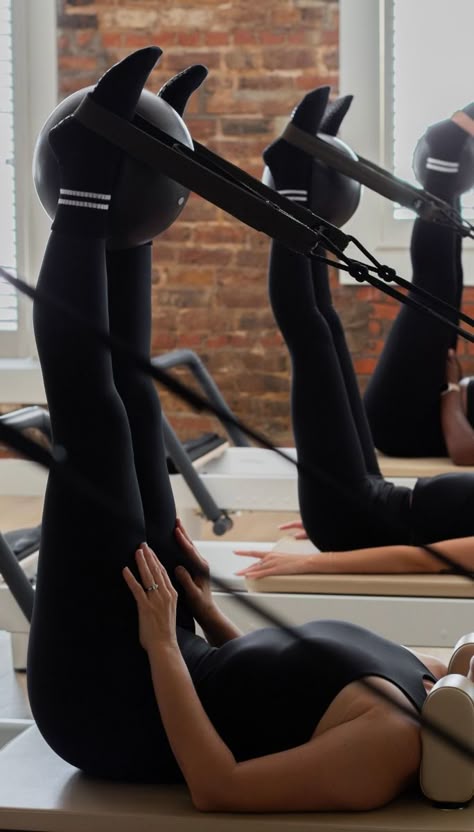
We include exercises that work on craniocervical mobility and strength, as well as the strength of the muscles of the rib cage and the back, arms and shoulders, using resistance with the springs provided by the apparatus of the method, which helps to strengthen the internal musculature, responsible for correctly positioning the joints and stabilising them with movement and postures.
Complementary Postural Hygiene Recommendations
At work and in everyday life, it is important to think about ergonomics and to be aware of certain postures in order to prevent decompensation. With good postural training, building strength and endurance in the core, back and spinal muscles will help us to maintain a good posture at a lower cost and automatically.
If we spend many hours in front of a computer or mobile device, keeping our concentration in front of a screen, we most often end up hunched over and with our neck and shoulders forward. It is good to establish some rules when consulting mobile devices in our free time, for example, avoiding it if we are on the move or if we are lying or lying down, as the position tends to be even more strained.
A common mistake is to sit on the edge of the chair, to have the chair too low or not to rest your elbows on the table if you have to write. We should also take into account not to lean more on one hip than the other or to avoid crossing our legs.
With good postural awareness we will pay more attention to the way we sit, keeping the lower back well supported, the neck straight, elbows supported and shoulders relaxed.
When sleeping, we should try to avoid the prone position, as the pressure will be on our lumbar spine, as its arching will increase, and on our cervical spine, as it will be extremely twisted. In addition, our organs will be compressed and our breathing will be less fluid.
When we stand for long periods of time, it is very common for our back to fall behind our pelvis, overloading the lumbar area due to a lack of strength in our centre and spine. As a consequence, our chest sinks and our upper back slouches, causing pain and cervical, dorsal or lumbar pathology.
It is a good idea to incorporate neck and shoulder relaxation exercises, stretching and mobility of the entire spine into your daily routine.
It is advisable to incorporate postural work into the routine with disciplines such as the Pilates method, which will strengthen the internal muscles of the entire spine and allow good posture to last over time. It will make the whole body work in a global way, balancing and distributing the weight well in that correct posture.
It is also a good idea to visit a physiotherapist from time to time to assess the structures that may be overloaded and to establish a treatment regimen of both manual and active exercise.
When to See Results with Pilates
Pilates is a demanding workout, both physically and mentally. It requires exhaustive concentration in order to deeply know and exercise the body and to be able to control it.
It doesn't take long to see results. Soon we will see how our body modulates and achieves the proposed objectives, but it is very important to be constant and patient when working with the method, as this is the only way to appreciate the results and benefits it brings.
Pilates sessions are always designed so that you finish the class with the real sensation of having worked all the muscles, from the deepest ones, which support our posture, to the more superficial ones that carry out the movements, maintaining good postural hygiene and correcting bad posture.
The ideal is to maintain a training routine of two sessions per week and progress gradually as you achieve the objectives of each exercise to challenge your body with more demanding exercises that require more control.
Additional Benefits of Pilates on Posture
With regular Pilates training, we achieve not only better alignment, strength and elasticity between our skeleton and the rest of the body structures, but also a better functioning of the musculoskeletal, visceral and nervous system.
The correct alignment of the spine, rib cage and pelvis helps us to achieve good posture and maintain the necessary space and movement between the viscera, favouring their functions, such as digestion, the circulatory and vascular system, or respiratory mechanics and capacity.
The correct use of breathing with good posture will facilitate the execution and efficiency of body movements, making them easier and with less effort.
The powerful work of the deep musculature of the energy centre or “Powerhouse” that is carried out in the sessions allows us to control our position in space and our mobility. A well-trained and efficient musculature of the deep central zone will make the movements require less effort, avoiding overloads, pain or injuries in muscles that are not prepared for it.
This strong, resilient and elastic “Powerhouse” musculature will enable you to maintain postures and positions throughout the day, at leisure or at work.
Frequently Asked Questions:
How long does Pilates take to correct posture?
From the very first session, and even with a low initial level, we will notice the work that our body is doing, integrating sensations, movements and forces that will help us to correct our posture over time.
Everything will also depend on how many hours and how much time and perseverance we dedicate to practising the method. The more continuous and constant the incorporation of this work into our routine, in a few weeks we will have gained more mobility, flexibility and strength and we will be more aware of our body and will be better able to control our postures.
Can Pilates help with neck and back pain?
If there is any injury or pain in the neck and back, the Pilates method is the most suitable training discipline to improve these symptoms and recover their function, as Pilates is a safe method that allows you to adapt and modify the exercises that need to be worked on and favours the process, not only guaranteeing the prevention of pain, but also restoring the functions of the structures that are affected, improving their symptoms.
Is it necessary to have previous experience to start postural Pilates?
It is not necessary to be an expert in Pilates to start enjoying its benefits. As a beginner and from the first session, the method will be a very effective resource for the body to learn to move correctly, distributing and dosing the load that we demand of it daily and preventing the appearance of injuries. Moreover, in each session, with its practice and in accordance with certain objectives, the body will be prepared for greater performance in any activity, sport, demand or daily task.
Tell us what you thought of this article, please rate it (1 TO 5 STARS).