
The Pilates method is a training discipline where the body works in a global way, improving qualities such as strength, flexibility, joint stability, balance, breathing and, in short, the functioning of the body as a whole through the development of body and postural awareness, integrating the use of the mind in connection with the musculoskeletal system.
The aim of the Pilates method for scoliosis is to work on and develop a balance between the muscle chains and joints through controlled movements from the strength of the “Powerhouse” o “energy centre”The aim is to find a balance between the two sides of the spine, from where all the forces should be directed towards the distal and external areas of the body, always seeking alignment and symmetry and placing great emphasis on the imbalance of muscular forces of the curvatures generated by scoliosis in the spine, where one side is stronger and the other weaker, in order to reach a balance between them.
What is scoliosis?
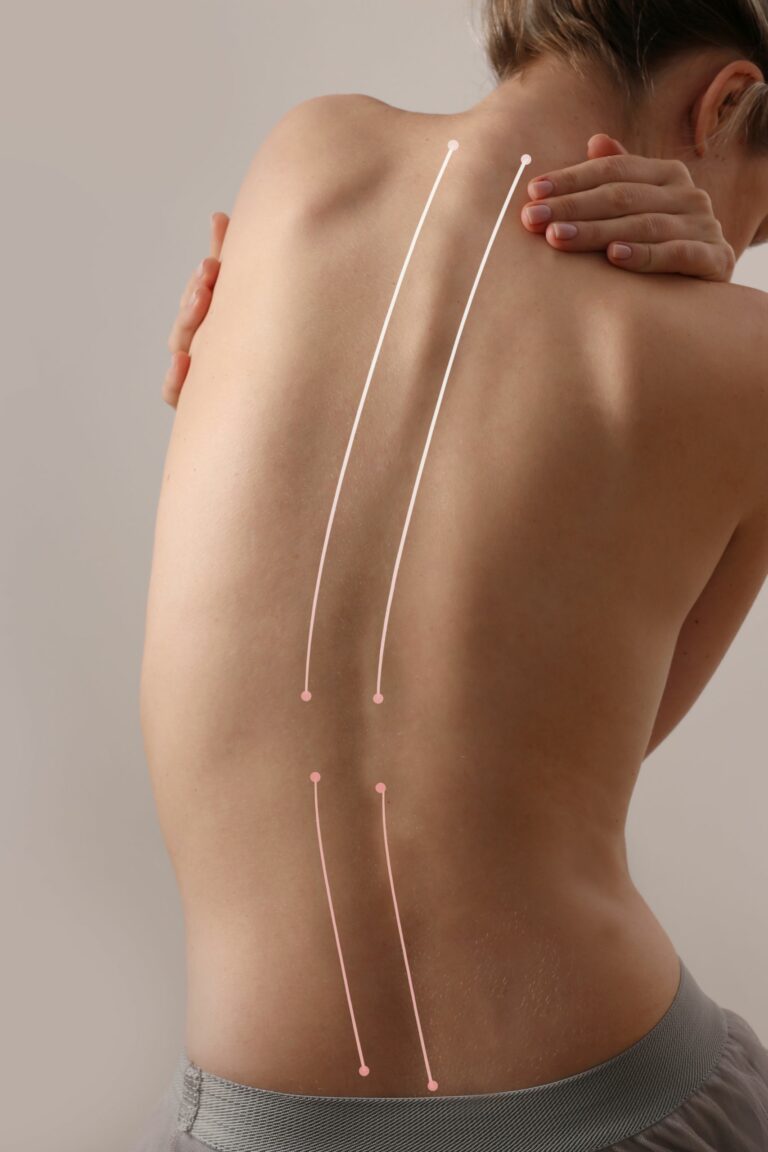
Scoliosis is a disorder of the spine, of mostly unknown cause, most common in children and adolescents, characterised by one or more lateral curvatures greater than 10° appearing as a “C” or “S” and associated with a rotation of the vertebrae and a reduced kyphosis in the thoracic curve, altering the shape of the natural, physiological curve of the spine.
Scoliosis generates a muscular imbalance on both sides of the spine, thus generating an asymmetry, with unevenness in the height of the hips (modifying the alignment of the legs and the tread) and of the shoulders (modifying the rib cage and breathing), resulting in a dorsal or lumbar hump.
Pilates exercises for scoliosis: the treatment
After the end of the growth phase, surgery is considered the only option for correcting scoliosis. However, through physical exercise and, in this case, with the Pilates method, and taking into account the layout of the scoliotic curves, it is possible to improve the muscular imbalances and other factors that intervene along the spine, aligning, strengthening and making it more flexible, maintaining good body functionality and preventing and protecting the spine from future problems caused by overexertion, poor posture, physical demands or lack of training and slowing down, as far as possible, the progression of the scoliosis.
How does it work?
One of the parts that the method establishes with its technique is the use of specific apparatus provided with springs and straps that offer assistance or resistance, depending on the objective to be worked on. In the case of scoliosis, we will seek to rebalance the muscular chains, as well as the symmetry between the articular structures, lengthening the muscles that are stronger and strengthening those that are weaker.
In addition, the work of our energy centre makes us strengthen our internal musculature that will stabilise our spine and, at the same time, will work on its mobility and flexibility, thus releasing pressure in areas such as the lumbar or cervical, which are usually more affected.
All the work of symmetry, alignment, lengthening of the spine and strengthening of our core musculature will be done in relation to our central line, which will run through the centre of our body seeking the elongation of our spine for a better positioning of the rest of the structures.
On the other hand, the breathing work makes us work the intercostal muscles, which, as well as helping us to increase our lung capacity, gives us more amplitude and mobility to our rib cage, especially in the areas where, depending on the arrangement of the curves, we will have more rigidity, shortening or less strength or flexibility.
The Pilates method is perfect for meeting these objectives and achieving more efficient movement, preventing discomfort and improving quality of life.
What exercises do we recommend?
All Pilates sessions consist of a main part with the use of the “Reformer” and another part on the “Mat” or mat, where we will choose some exercises in which we will deepen a little more the needs of the person, in this case with scoliosis.
They will be exercises where:
- We will continue to strengthen the centre: “Abdominal series”.”
- Strengthening the back and core: “One leg circles”, “Corkscrew”,
- We will mobilise and articulate the spine: “Roll up”, “Saw”, “Neck pull”.”
- We will work on alignment in all exercises.
- We will work on the amplitude of the rib cage with breathing: “Spine Stretch forward”, “Neck Pull”.”
Afterwards, we will use other apparatus from the rest of the system to work more analytically on what needs to be complemented with the work done on the reformer and mat, based on your scoliosis.
With these Pilates exercises for scoliosis we work on the muscular imbalances of the spine giving strength, stretching and mobility with positions sideways like “Mermaid” in Cadillac, or in Wunda chair; “Press down one arm” in Wunda chair.
Or using other apparatus such as the “Baby Chair” in which we work on the strength of the back and the shoulder girdle; or the “Spine Corrector” where we will free the spine, rib area, among other objectives.
Why choose Elite Pilates?
At Elite Pilates For twenty years we have been dedicated to improving the quality of life of all those who have placed their trust in us. Behind every client there is a story full of hard work, improvement and affection. We are proud to have their trust, loyalty and gratitude.
We treat children as young as 10 years old, people over 90 years old and pregnant women. Anyone can enjoy the benefits of the method.
We design original Pilates classes, only for individuals, which allow us to offer a personalised, tailor-made service, always guaranteeing a unique, effective and unrepeatable training.
We first carry out an initial assessment of the client to determine their physical condition and characteristics in order to establish a criteria with their needs, adapting and modifying what the person needs to improve their state of health, increase their state of wellbeing and prevent any damage or injury.
An added value in all the professionals of the centre is their training as physiotherapists, which provides a vision with clinical knowledge, of high quality, maintaining a constant training to be able to offer our services with an increasingly updated vision.
The multidisciplinary nature of the team means that we can offer the additional advantage of including the Pilates method in the treatment of ailments and injuries that we are working on with physiotherapy, guaranteeing an improvement in their final stages, reaching a complete and quality rehabilitation.
In our sessions, in order for the work to be complete and to achieve real effectiveness, we use both the mat and all the different apparatus of the method. A true Pilates session for scoliosis should combine both, with the teacher always stipulating the most appropriate exercises in each case.
Tell us what you thought of this article, please rate it (1 TO 5 STARS).